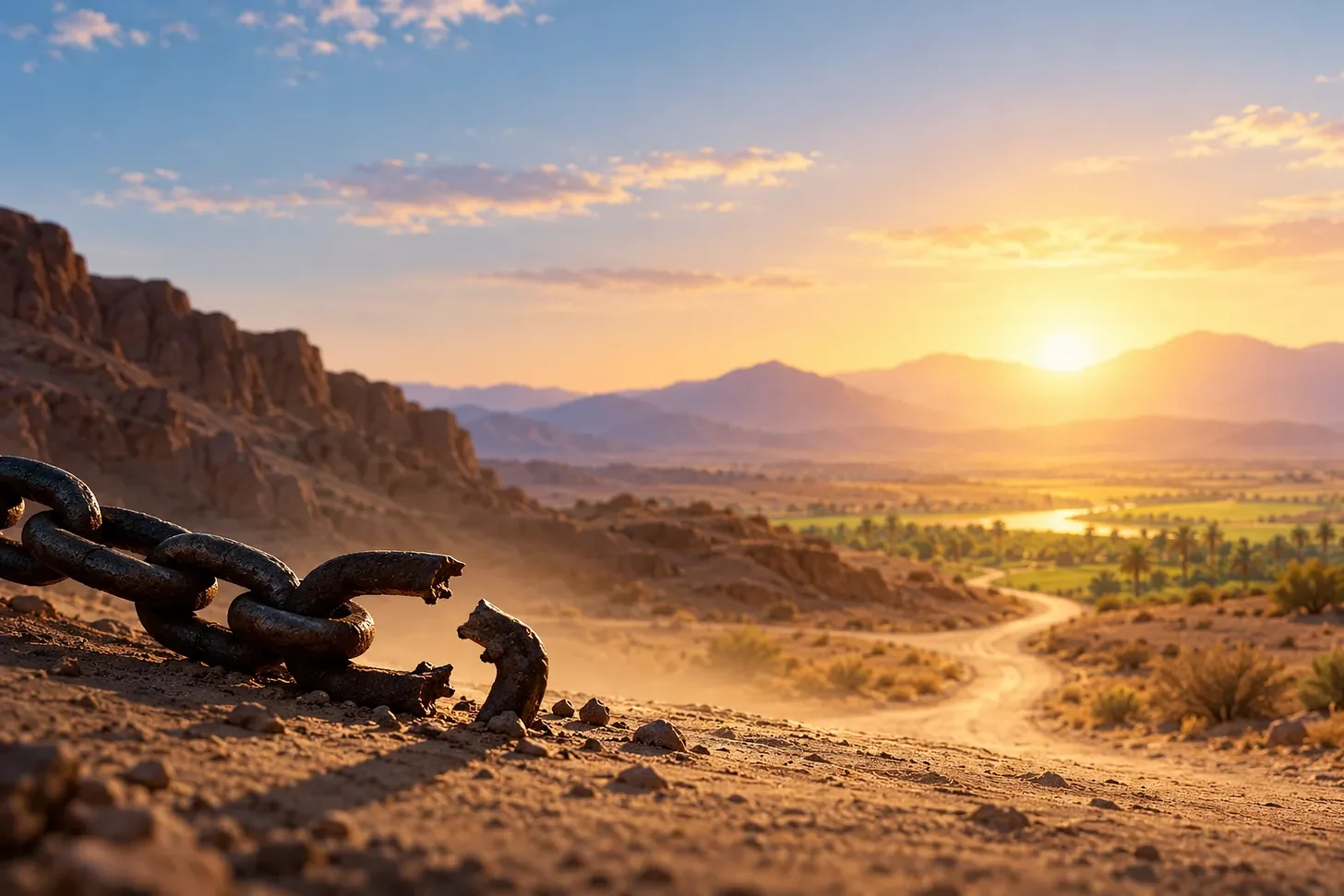
Sometimes the biggest obstacle isn't your circumstances. It's how you see them.
We all have a picture of what we want our lives to look like.
Perhaps it’s owning your first home, building a successful business, providing a better life for your family or reaching a point where money is no longer a constant worry.
You could call it our own version of a promised land.
For the Israelites, however, the Promised Land wasn’t just an idea of a better future. It was a physical place called Canaan.
After generations of slavery in Egypt, God had promised them a land of their own, described as flowing with milk and honey. It represented freedom, security and the opportunity to build a new life.
Yet despite escaping Egypt, most of the adults who left never made it to Canaan.
They were free from slavery, but still couldn’t reach the place they had been promised.
So what went wrong?
⏳ An 11-Day Journey That Took 40 Years
According to Deuteronomy 1:2, the journey from Mount Horeb to Kadesh Barnea, near the Promised Land, normally took 11 days.
Yet the Israelites spent 40 years in the wilderness before the next generation entered Canaan.
The 11 days didn’t cover the entire journey from Egypt, but the real problem wasn’t the distance.
In Numbers 13, Moses sent twelve spies to explore Canaan. After forty days, they returned with evidence that the land was fertile, but its inhabitants were powerful and its cities heavily fortified.
Ten spies believed they couldn’t overcome these obstacles. Joshua and Caleb disagreed.
They saw the same land but reached very different conclusions.
In Numbers 13:33, the ten spies said:
“We seemed like grasshoppers in our own eyes, and we looked the same to them.”
Before any battle had taken place, they had already decided they were too small to win.
Their report spread fear among the Israelites, who even discussed returning to Egypt rather than entering Canaan.
As a consequence of their refusal to trust God, that generation was told they would not enter the Promised Land, apart from Joshua and Caleb.
The difference wasn’t what the spies saw. It was how they saw themselves.
🧠 They Left Egypt. But Egypt Hadn’t Left Them.
The Israelites were physically free, but they continued to think like slaves.
Whenever they faced difficulties, they looked back at Egypt.
The familiarity of the past had become more comfortable than the uncertainty of the future.
And I think we can all relate to that.
Perhaps you’ve spent years struggling financially and have come to believe that money will always be a problem.
Or you’ve experienced failure and now avoid opportunities because you’re afraid of getting it wrong again.
Sometimes we become so accustomed to our circumstances that we struggle to imagine anything different, even when our situation improves.
Our circumstances can change long before our mindset does.
When someone is physically chained, they can see what’s holding them back.
But what happens when the chains are in your mind?
💰 The Biggest Battle Is in Your Mind
I often say that personal finance is 80% psychology and 20% mathematics.
And the maths behind building wealth is relatively straightforward.
Spend less than you earn.
Save consistently.
Avoid unnecessary debt.
Invest for the long term.
Give your money time to compound.
But knowing what to do and actually doing it are two very different things.
Someone might understand the benefits of investing but never start because they’re afraid of losing money.
Another person might have a business idea but spend years waiting for the perfect moment.
Someone else might earn considerably more than they did growing up, yet still make every financial decision from a place of fear and scarcity.
The numbers might have changed, but their relationship with money hasn’t.
And this is something I often come across when helping people navigate their finances.
Sometimes the challenge isn’t knowing how to budget, save or invest. It’s recognising the beliefs and habits that influence our decisions.
Financial education and coaching can help bridge that gap between knowing what to do and actually doing it.
Because you can have all the financial knowledge in the world, but if fear keeps you from using it, very little changes.
🔑 Freedom Requires a Different Way of Thinking
The Israelites didn’t just need to leave Egypt.
They needed to learn how to live as free people.
For generations, their lives had been controlled by others. Now they were being asked to face uncertainty, take responsibility and trust God in unfamiliar circumstances.
That required a different way of thinking.
And I think the same is true of our finances.
Earning more money doesn’t automatically mean you’ll manage it better.
Someone can receive a significant pay rise and still live from payday to payday if your spending rises alongside their income.
Someone else might pay off their debts, only to slip back into the habits that got them into debt in the first place.
And someone can dream about financial independence for years without ever taking the steps needed to work towards it.
The issue isn’t always a lack of opportunity or money.
Sometimes it’s the habits and beliefs we’ve never challenged.
A change in circumstances doesn’t automatically produce a change in behaviour.
🌱 Don’t Let Your Past Determine Your Future
Perhaps the greatest distance the Israelites needed to travel wasn’t between Egypt and Canaan, but between their hearts and their minds.
They wanted the Promised Land, but struggled to believe they could reach it. Despite everything they had witnessed, fear and unbelief held them back.
And I wonder how often we do the same.
We have dreams and ambitions, but allow past experiences to determine what we believe is possible.
Financial hardship, limited opportunities and other challenges are very real. We can’t always control our circumstances.
But we can challenge the beliefs that hold us back.
Often, changing our lives begins with changing what we believe is possible.
The next generation entered Canaan under Joshua’s leadership, but most of the adults who had left Egypt never reached the land they had been promised.
Their story leaves us with a question worth sitting with this Sunday:
You may have left Egypt. But what beliefs are you still carrying that make it hard to move forward?