Does saying “I do” make you wealthier, or could it be the most expensive decision of your life?
Outside of one’s relationship with God, I believe the person you choose to marry is one of the most important decisions you’ll ever make.
Think about it. That one decision can influence where you live, how you raise your children, the opportunities you pursue and ultimately the kind of life you build.
As someone of faith, I believe marriage is God’s design and that there is something good in it. And given my interest in finance, I’m curious whether those benefits extend to our financial wellbeing.
Does marriage actually make you wealthier? And if so, how much of a difference does it make?
⏳ Why Are We Getting Married Later?
I got married at 23, making me one of the first to get married in many of my friendship groups (fine, all my friendship groups 😂).
Quite a few have since followed suit, but many remain unmarried. Interestingly, I’ve noticed that a lot of them are women.
And that got me thinking.
According to the Office for National Statistics, the median age at marriage in England and Wales was 25.8 for men and 23.2 for women in 1980. By 2023, those figures had risen to 34.8 and 33, respectively.
That’s almost a decade later.
I’ve wondered whether women’s growing financial independence has something to do with it.
Historically, marriage often provided economic security, particularly when women had fewer opportunities to earn and build wealth independently.
With greater access to education, employment and financial independence, could women now feel less financial pressure to get married?
Of course, that’s just one possible explanation. Changing expectations, housing costs and financial uncertainty may also influence when people choose to marry.
But it raises an interesting question:
If marriage is no longer a financial necessity for some people, what are the economic benefits of choosing it?
💷 Does Marriage Actually Make Financial Sense?
The most obvious financial advantage of being in a relationship is sharing expenses.
Two people living together can split rent, utilities, food and other household bills, potentially leaving more money available to save and invest.
But you don’t need to be married to benefit from that.
The distinction becomes more interesting when we look at the UK’s tax and inheritance rules.
Some benefits come from simply living together. Others are specifically available to married couples and civil partners.
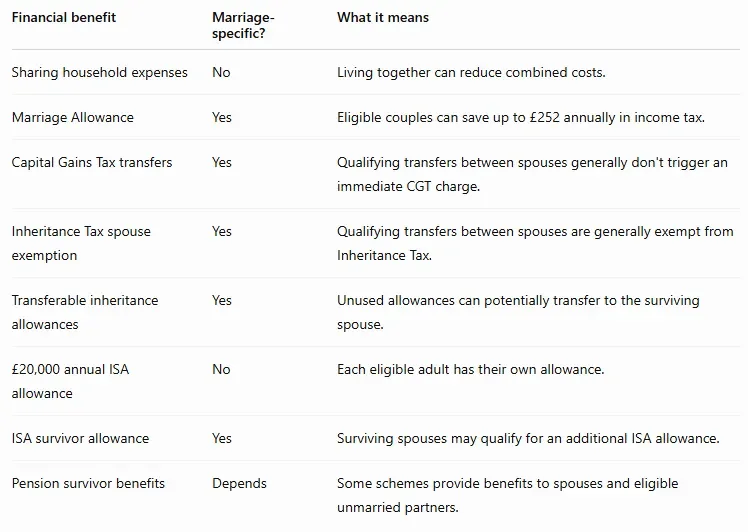
These are just some examples, and the financial value varies considerably depending on your circumstances.
For example, Marriage Allowance allows eligible couples to save up to £252 annually.
If one spouse earns £10,000 and the other £35,000, the lower earner can transfer up to £1,260 of their unused tax-free allowance.
£1,260 × 20% = £252 saved in tax each year.
£1,260 is the maximum transferable amount, even if more of the allowance is unused. Eligible couples can also backdate claims by up to four previous tax years.
That’s useful, but hardly a reason to get married.
The more significant advantages can arise when couples are protecting and passing on wealth.
The £1 Million Inheritance Tax Advantage
In the UK, individuals generally have a £325,000 Inheritance Tax nil-rate band, which is the amount their estate can pass on before Inheritance Tax becomes payable, assuming no other reliefs or exemptions apply.
There is also an additional £175,000 residence nil-rate band where a qualifying home is left to direct descendants.
For married couples, unused allowances can potentially transfer to the surviving spouse’s estate.
Let’s use an example.
Imagine a married couple builds an estate worth £1 million, including their family home.
When the first spouse dies, their assets pass to the surviving spouse, generally without an Inheritance Tax charge where the spouse exemption applies.
When the surviving spouse eventually dies and leaves the estate to their children, both sets of unused allowances may be available.
£650,000 in combined nil-rate bands + £350,000 in residence nil-rate bands = £1 million.
Subject to the relevant conditions, the family could potentially pass on the entire estate without paying Inheritance Tax.
Unmarried couples don’t receive the same spouse exemption or the ability to transfer unused allowances.
There are important conditions. The additional residence allowance requires a qualifying home to pass to direct descendants and starts reducing when the estate exceeds £2 million.
The ISA Benefit Most People Don’t Know About
Every eligible adult has a £20,000 annual ISA allowance, whether married or not.
However, if your spouse dies, you may qualify for an Additional Permitted Subscription (APS).
For example, if your spouse had £150,000 in ISAs, you could receive an additional £150,000 ISA allowance on top of your usual £20,000.
That’s potentially £170,000 you could put into ISAs, instead of £20,000.
This is extra tax-free investment capacity, not an automatic inheritance of the money.
📚 Does Marriage Actually Make You Wealthier?
If you’ve spent enough time on Instagram, you’ve probably seen claims that married men earn more than single men.
Economists call this the marriage wage premium. However, research is mixed on whether marriage itself increases earnings or whether higher earners are simply more likely to marry.
But earnings are only one part of the picture. What about wealth?
A 2020 German study followed people’s finances over time and found that the wealth advantage associated with marriage increased the longer people were married, particularly through property ownership.
Importantly, the researchers accounted for some differences between individuals, making the comparison more meaningful than simply comparing average wealth.
However, the findings don’t prove that marriage alone created the additional wealth.
Still, I wonder whether marriage changes how people approach their finances.
Having a spouse and children to provide for may encourage greater ambition, discipline and resourcefulness. After all, necessity is the mother of invention.
Building a family can also involve financial sacrifices, such as one spouse reducing their working hours to raise children.
But financial success isn’t always about maximising income. Sometimes it’s about making choices that benefit the family as a whole.
📉 Divorce Is Bad for Business
While marriage offers financial benefits, divorce can be costly.
One household becomes two, assets may need to be divided, and years of financial planning can be disrupted.
It’s a reminder that who you marry, and how you manage your finances together, can have lasting financial consequences.
✝️ So, Is Marriage Worth It?
Ecclesiastes 4:9 says: “Two are better than one, because they have a good return for their labour.”
I don’t believe marriage guarantees wealth. But the financial evidence suggests there are real benefits to building a life together.
And perhaps that’s the greatest lesson from this exercise.
Marriage isn’t a guarantee of financial success. But choosing the right person can be one of the greatest investments you ever make.