Understanding the fees that can eat into your investment returns
Not too long ago, investing was much more expensive and difficult for everyday people to access.
Buying shares often involved stockbrokers, significant dealing charges and minimum investment amounts that made getting started costly.
But things have changed.
The rise of online investment platforms and neobrokers has made investing more accessible than ever.
Today, some platforms allow you to start investing with as little as £1, while others promote commission-free trading.
And with a single ETF or mutual fund, you can gain exposure to hundreds or even thousands of companies across different countries and industries.
Today, everyday investors can access many of the same investment strategies used by professional investors, including pension funds, wealth managers and private banks.
But while getting started has become easier and cheaper, that doesn’t mean investing is free.
Investment platforms and fund providers are businesses. They need to generate revenue, whether through management fees, platform subscriptions, currency conversion charges or other services.
And even when a platform advertises commission-free investing, there may still be costs associated with buying, holding or selling your investments.
🍬 Same Product. Different Price.
Think about buying a bag of Haribo.
You might pay £1.50 at Asda but find the same bag selling for £3 at the cinema.
Same sweets. Different price.
Where you buy something can make a big difference to what you pay.
The same principle applies when buying investments.
You could buy exactly the same ETF, mutual fund or individual share through two different investment platforms and end up paying different fees.
One might charge you to hold your investments. Another might charge every time you buy or sell.
These costs matter because every pound spent on fees is a pound that isn’t contributing to your investment returns.
So what should you look out for?
🏦 Part 1: Costs Within Your Investment
When you invest through an ETF or mutual fund, the provider incurs costs to create, manage and operate it.
These costs can affect your returns, even if you never receive a separate bill.
1. Management Fees
Think of the management fee as a subscription fee you pay a fund provider for creating and managing an investment product you can access.
For example, you can’t invest directly in the S&P 500 Index, but you can buy an ETF or mutual fund designed to track its performance.
The provider creates and manages that investment on your behalf.
How much it charges can depend on the strategy.
Passive funds aim to track an index, such as the S&P 500 or MSCI World.
Active funds have investment professionals making decisions about what to buy and sell, often with the aim of outperforming a benchmark.
Active funds generally charge higher management fees because they often involve more research and investment decisions.
But higher fees don’t guarantee better performance.
2. Other Costs Within Funds
Management isn’t the only expense involved in running an ETF or mutual fund.
Other costs can include:
Index licensing fees: What an index-tracking fund pays to use an index such as the S&P 500 or MSCI World.
Portfolio transaction costs: Costs incurred when the fund buys or sells investments.
Swap fees: Costs associated with financial contracts used by some ETFs to track an index. A swap is an agreement, often with a bank, to exchange financial returns.
Currency-hedging costs: Costs or benefits associated with reducing the impact of exchange-rate movements.
Not every fund incurs all these costs.
What About TER and OCF?
When researching ETFs or mutual funds, you’ll often see a percentage labelled TER (Total Expense Ratio) or OCF (Ongoing Charges Figure).
These are measures of the fund’s ongoing running costs, generally including management fees, index licensing and other operating expenses.
Although TER and OCF are often similar, they aren’t always calculated in exactly the same way.
And importantly, the published figure may not include every cost affecting your investment returns, such as portfolio trading costs or certain swap-related expenses.
So don’t assume the fund with the lowest TER or OCF is automatically the cheapest overall.
You can usually find more information in the fund’s factsheet and regulatory documents, such as its Key Information Document (KID) or Key Investor Information Document (KIID).
📱 Part 2: Costs of Buying, Holding and Selling Investments
These costs depend on your investment platform and how you invest.
They can apply to ETFs, mutual funds and individual shares, although the exact charges vary.
3. Platform Fees
Your investment platform may charge you for maintaining your account.
Some charge a percentage of your portfolio, others charge a fixed monthly fee, and some offer accounts with no platform fee.
For example:
Buying a Vanguard ETF through Vanguard’s own platform isn’t necessarily the cheapest way to own it.
(Vanguard operates as both a fund provider and an investment platform.)
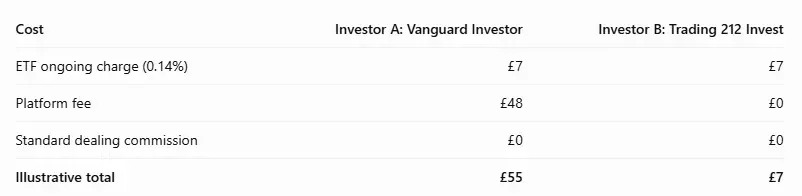
Take the Vanguard FTSE All-World UCITS ETF (VWRP).
The ETF has an ongoing charge of 0.14%, regardless of whether you buy it through Vanguard Investor or another platform offering the same share class.
But the platform fees can differ.
Imagine investing £5,000 in VWRP for one year.
Why the difference?
Vanguard Investor charges £4 per month (£48 annually) for self-managed accounts below £32,000, while Trading 212 Invest has no platform fee.
Same ETF. Same investment amount. Different costs.
That’s why it’s worth comparing platform fees before deciding where to invest.
Of course, the cheapest platform isn’t automatically the best. Customer service, account features and available investments may also influence your decision.
4. Dealing and Brokerage Fees
A dealing fee, sometimes called a brokerage commission, is what your broker may charge when you buy or sell an investment.
Imagine your platform charges £5 per trade.
If you invest £100, that fee represents 5% of your contribution.
But if you invest £5,000, the same fee represents just 0.1%.
That’s why fixed dealing fees can be particularly significant for people investing smaller amounts regularly.
Again, some platforms offer commission-free trading or free regular investment plans.
But commission-free doesn’t necessarily mean cost-free.
5. Foreign-Exchange Fees
If your account holds pounds but you buy an investment traded in US dollars, your platform may charge a currency-conversion fee.
For example, investing £1,000 with a 0.75% FX fee would cost £7.50.
You may also pay another conversion fee when selling.
This is different from currency risk, which is how exchange-rate movements affect your investment’s value.
An FX fee is a transaction charge. Currency risk is an investment exposure.
6. Bid-Ask Spreads
This is one of the less obvious costs of buying and selling shares and ETFs.
When you trade, there are usually two prices:
Bid price: What someone is willing to pay to buy the investment from you.
Ask price: What someone is willing to accept to sell it to you.
The difference is the bid-ask spread.
Imagine an ETF showing:
Buy price: £100.10
Sell price: £99.90
The spread is 20p, approximately 0.20%.
If you bought and immediately sold at those prices, you’d lose 20p per share, even if the underlying investment hadn’t moved.
This isn’t usually a separate fee. It’s built into the prices at which you trade.
What Affects the Spread?
One important factor is liquidity.
Liquidity means how easily you can buy or sell an investment without significantly affecting its price.
For example, widely traded shares are generally easier to buy and sell than investments that rarely change hands.
Spreads can also be affected by market volatility, competition between market makers and whether the underlying markets are open.
The easier and less risky an investment is to trade, the tighter its spread will often be.
Traditional mutual funds generally work differently. They’re usually bought and sold at a calculated fund price rather than through continuously quoted exchange bid and ask prices, although pricing adjustments or dilution charges can sometimes apply.
7. Taxes and Other Charges
Depending on what you invest in and where you live, taxes can also affect your returns.
For example, buying many UK company shares attracts 0.5% Stamp Duty Reserve Tax, while ordinary purchases of ETFs on the London Stock Exchange are generally exempt.
Taxes on dividends and capital gains may also apply, depending on your circumstances and whether you’re investing through an ISA, pension or taxable account.
These aren’t necessarily broker fees, but they’re still worth understanding.
🧩 Can Funds Offset Some of Their Costs?
Interestingly, some ETFs and mutual funds can generate additional income through securities lending.
This involves temporarily lending investments they own, such as shares, to another financial institution in exchange for a fee.
The borrower provides collateral as security, and the fund earns income from the arrangement.
That additional income can help offset some of the fund’s costs and improve returns, although securities lending also carries risks.
It’s another reason why two funds tracking the same index can deliver slightly different returns, even when their published fees are similar.
🔍 Five Things to Check Before Investing
1. Check the ongoing charges. If you’re investing in an ETF or mutual fund, understand its management fee and published TER or OCF.
2. Compare platform fees. The same investment can cost different amounts depending on where you hold it.
3. Check dealing and FX charges. Particularly if you’re investing smaller amounts regularly or buying overseas investments.
4. Understand trading costs. Bid-ask spreads can affect the cost of buying and selling shares and ETFs.
5. Consider the overall cost. Look beyond one headline fee and think about the cost of buying, holding and eventually selling your investments.
Most fund providers publish their charges in factsheets and product documents, while investment platforms provide their own fee schedules.
💭 The Bottom Line
Investing has become more accessible, and that’s something worth celebrating.
But lower barriers to entry don’t mean we should stop paying attention to costs.
Two investors can own exactly the same investment and pay different amounts simply because of where and how they invest.
And while individual fees may seem small, they can add up over time.