
You Bought the S&P 500… What Next? (Part 4)
Understanding Emerging Markets, Growth and Global Opportunity 📈🌏
Over the last few weeks, we’ve explored several ways investors can build around a traditional global equity portfolio.
We’ve covered:
🎯 Thematic Investing
₿ Cryptocurrency & Digital Assets
🌾 Commodities & Real Assets
🌏 Emerging Markets
This article marks the final instalment in the series.
Importantly, these aren’t the only investments available beyond broad global equity benchmarks.
Investors may also consider:
small-cap equities
sector-specific funds
real estate
private markets
infrastructure
individual stocks
and many other specialist allocations
The goal of this series wasn’t to provide an exhaustive list.
Instead, it was to introduce some of the most common ways investors think about building around a core portfolio and explore the opportunities and risks associated with each.
This week, we’re looking at Emerging Markets.
And if you already own a global equity fund, pension, or an index such as the MSCI ACWI or FTSE All-World, you probably already have some exposure.
The real question is:
Am I comfortable with how much I already own?
That is the conversation we are really having.
Why Emerging Markets Matter 🌍
At the simplest level, Emerging Markets are countries that still have room to grow.
They are not as mature as developed markets, but they are not at the earliest stage of development either.
Examples include:
China 🇨🇳
India 🇮🇳
Brazil 🇧🇷
Mexico 🇲🇽
Indonesia 🇮🇩
South Africa 🇿🇦
Many of these countries are experiencing:
rising incomes 📈
urbanisation 🏙️
growing middle classes 💰
expanding infrastructure 🏗️
increasing consumer spending 🛒
That is what attracts investors.
The case is not just about where these economies are today.
It is about where they may be tomorrow.
It Is Not Always Black and White 🤔
One thing that surprises many investors is that different index providers do not always agree on which countries count as Emerging Markets.
Take South Korea 🇰🇷
MSCI classifies South Korea as an Emerging Market.
FTSE Russell classifies South Korea as a Developed Market.
Same country.
Different classification.
Why?
Because providers do not just look at economic size.
They also consider how accessible the market is to international investors and how easy it is to trade, settle and move capital in and out.
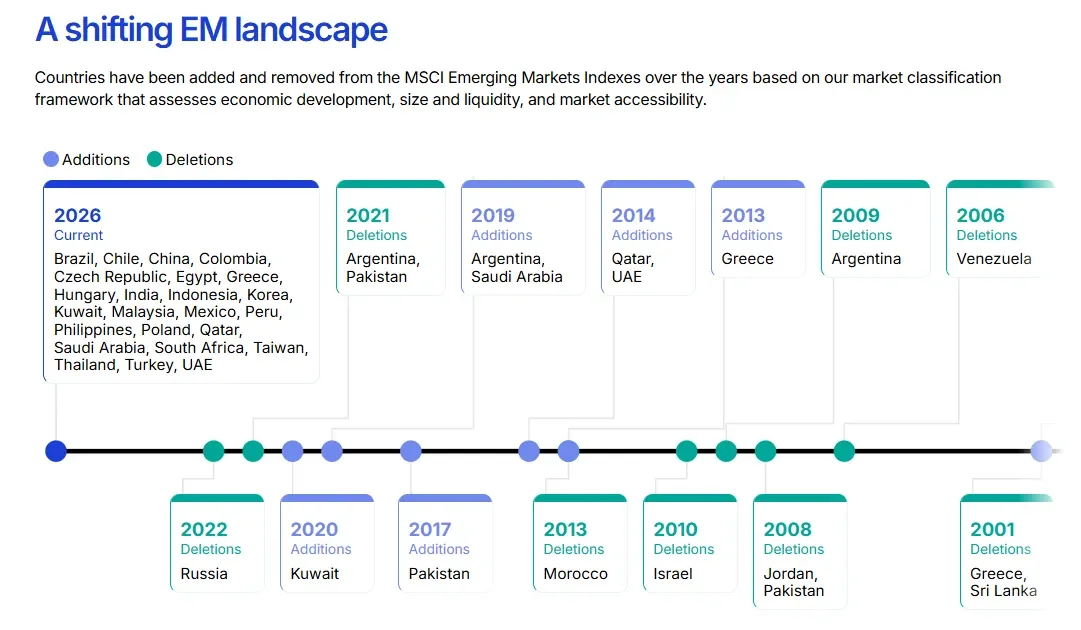
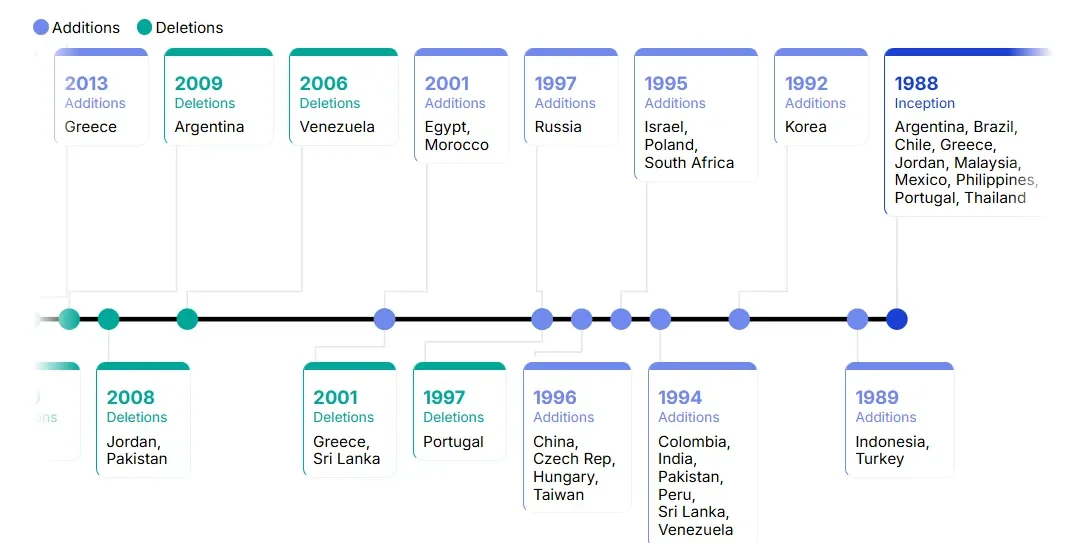
This is why countries can move into and out of Emerging Market indices over time.
The MSCI timeline is a good example of that.
Over the years:
Saudi Arabia was added
Kuwait was added
Greece was downgraded
Russia was removed
Argentina moved in and out multiple times
The lesson is simple:
Emerging Markets are not a permanent label.
They are an evolving part of the investment universe.
China and India: Why the Debate Exists 🇨🇳 🇮🇳
Many investors are surprised to learn that China and India remain classified as Emerging Markets.
After all:
China is the world’s second-largest economy.
India is one of the world’s fastest-growing major economies and home to the world’s largest population.
So why are they still called Emerging Markets?
Because the label is not just about economic size.
It is also about how accessible the markets are for investors, how the systems are structured, and how easy it is to put capital to work there.
That is why some investors debate whether the label still fits.
But regardless of the label, it highlights an important point:
Emerging Market status is not simply about GDP.
What About Frontier Markets? 🚧
Some countries sit one step earlier in the development journey and are often classified as Frontier Markets.
Examples include:
Vietnam 🇻🇳
Bangladesh 🇧🇩
Kenya 🇰🇪
Sri Lanka 🇱🇰
Many of these economies are growing rapidly.
So why are they not classified as Emerging Markets?
Because growth alone is not enough.
Investors also need:
liquid stock markets
sufficient trading volumes
reliable settlement systems
and efficient access for foreign investors
This is why economic growth and market accessibility do not always move together.
Why Investors Find Emerging Markets Attractive 🚀
Ultimately, investors do not buy Emerging Markets because they enjoy classifications.
They invest because they believe some of the world’s future growth may come from these countries.
Demographics 👶
Many developed countries face:
ageing populations
slower workforce growth
lower birth rates
Many Emerging Markets still benefit from:
younger populations
growing workforces
and expanding middle classes
Why does that matter?
A younger working population can mean:
more workers
more consumers
more spending power
and potentially faster economic growth
This is one reason demographics can be such a powerful tailwind.
Urbanisation 🏙️
As people move from rural areas into cities, economies often become more productive.
Urbanisation can drive:
housing demand
transport networks
infrastructure investment
financial services
and consumer spending
Many Emerging Markets are still moving through this transition.
Economic Growth 📈
Many emerging economies continue to grow faster than developed markets.
Technology adoption.
Infrastructure investment.
Rising incomes.
More consumer demand.
These trends can create opportunities for businesses and investors alike.
Why Some Investors Overweight Emerging Markets 🌏
Many global benchmarks, such as MSCI ACWI and FTSE All-World, remain heavily dominated by developed markets, particularly the United States.
That means many investors already have a lot of developed-market exposure in their portfolios.
But some investors believe Emerging Markets deserve more than the benchmark gives them by default.
Why?
Because these countries represent:
a large share of the world’s population
a growing share of global consumption
increasing manufacturing activity
and a meaningful part of future economic growth
So the question becomes:
Do I want to simply accept the market weight?
Or do I want to make a deliberate decision to own more?
That is a portfolio construction question, not just a geographic one.
Higher Growth Potential Usually Comes With Higher Risk ⚠️
If Emerging Markets always outperformed, everyone would own them.
But the reality is more complicated.
Emerging Markets often come with additional risks including:
💱 Currency risk
🏛️ Political risk
⚖️ Regulatory risk
🏢 Governance risk
📉 Liquidity risk
And perhaps the most important lesson of all:
Strong economic growth does not automatically lead to strong stock market returns.
A country can grow quickly while investors still experience disappointing returns.
That is one reason Emerging Markets can be more volatile than developed markets.
So Where Do Emerging Markets Fit In A Portfolio? 🛰️
For many investors, Emerging Markets sit somewhere between a core and satellite allocation.
Some global funds already include Emerging Markets.
Others choose to allocate more deliberately.
The key question becomes:
Am I happy with the Emerging Market exposure already included in my portfolio?
Or:
Do I want more exposure to future growth outside developed markets?
There is no perfect answer.
Only an answer that aligns with:
your goals
your time horizon
and your risk tolerance
Final Thoughts 🌍
This article marks the final instalment in our series exploring investments beyond traditional global equity benchmarks.
Over the last few weeks we’ve covered:
🎯 Thematic Investing
₿ Cryptocurrency & Digital Assets
🌾 Commodities & Real Assets
🌏 Emerging Markets
While these are some of the most commonly discussed satellite allocations, they are far from the only options available to investors.
The broader lesson remains the same:
Understanding what you own matters.
Whether you’re investing in global equities, thematic trends, commodities, crypto or Emerging Markets, each asset plays a different role within a portfolio.
Emerging Markets are ultimately a bet on progress.
A belief that countries still building their infrastructure, industries and consumer base may create meaningful investment opportunities over time.
But that opportunity comes with higher risk and greater uncertainty than developed markets.
Whether you choose to accept the benchmark allocation or invest more heavily is ultimately a portfolio construction decision.
Because investing is not just about understanding where growth has been.
It is about understanding where growth may come from next.