A Beginner's Guide to Commodities, Futures Markets and Real Assets 🌾
Most people don’t wake up thinking about commodity markets.
Yet before you’ve even checked your emails, you’ve already interacted with them.
The electricity powering your kettle ⚡
The coffee in your mug ☕
The petrol in your car ⛽
The copper in your phone 📱
Commodity markets sit behind all of them.
Over the last few weeks, we’ve explored a few different areas investors might consider beyond a traditional global equity portfolio.
We started with thematic investing.
Then we looked at cryptocurrency and digital assets.
This week, we’re looking at something much older.
In fact, commodities were being traded centuries before stock markets, ETFs or Bitcoin ever existed.
And while commodities may not generate the same excitement as artificial intelligence or cryptocurrency, they remain some of the most important assets in the world.
Because before we can:
build data centres,
manufacture electric vehicles,
construct homes,
expand power grids,
or generate electricity,
we need raw materials.
We need commodities.
In many ways, commodities are the building blocks of the global economy.
The Farmer, The Baker and the Birth of Futures Markets 🌾
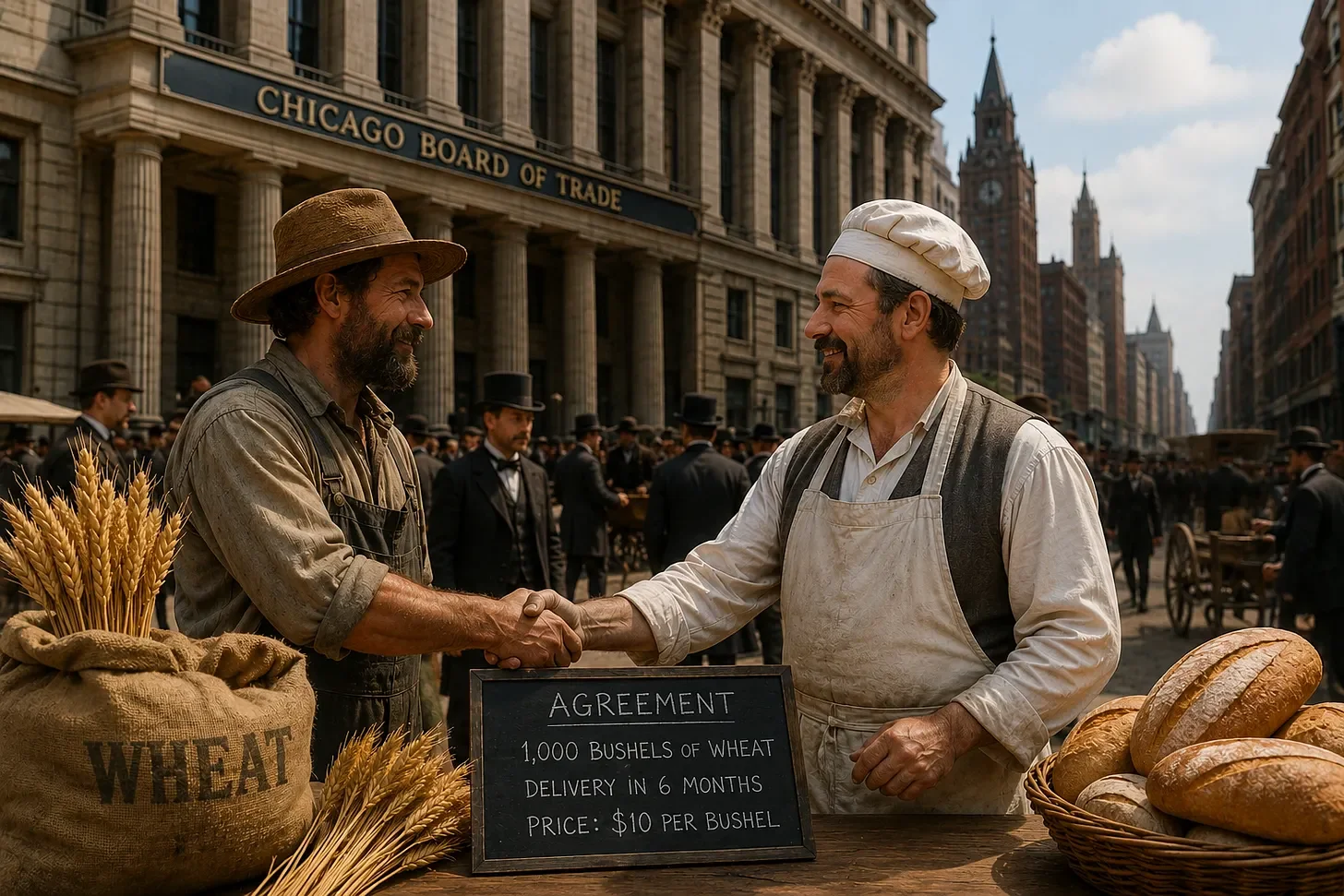
Imagine you’re a wheat farmer.
You’ve planted this year’s crop, but harvest is still months away.
Between now and then, a lot can happen.
A bumper harvest could flood the market and send wheat prices crashing 📉
A poor harvest could send prices soaring 📈
The problem is simple.
You have no idea what your wheat will be worth when harvest arrives.
Meanwhile, a baker has the opposite problem.
The baker knows they’ll need wheat later in the year but has no idea what the price will be.
The farmer fears prices falling.
The baker fears prices rising.
So they make a deal today.
“I’ll sell you 1,000 bushels of wheat in six months for £10 per bushel.”
Neither side knows whether this will prove to be a good deal.
But both sides gain something valuable:
certainty!
This simple agreement became the foundation of one of finance’s most important innovations:
The futures contract.
Chicago Changed Everything 🌎
While versions of these agreements existed long before, the modern futures market was born in Chicago.
In the 1800s, Chicago sat at the centre of America’s agricultural economy.
Farmers from across the Midwest brought wheat, corn and oats into the city for sale.
The problem?
Harvests arrived all at once.
Supply surged.
Prices collapsed.
Months later, supplies became scarce and prices often rose sharply.
To solve this problem, merchants began agreeing prices in advance.
In 1848, the Chicago Board of Trade (CBOT) was established.
The exchange standardised contracts by specifying:
quantity,
quality,
delivery date,
delivery location.
Instead of negotiating every trade individually, buyers and sellers could trade standardised contracts.
The modern futures market was born.
Today, commodity markets are traded globally through exchanges such as:
CME Group (Chicago)
London Metal Exchange (LME)
ICE Futures Europe
Shanghai Futures Exchange
While wheat helped create the futures market, today’s exchanges facilitate trading across:
energy,
metals,
agriculture,
currencies,
stock indices,
interest rates,
and even Bitcoin futures.
Futures Markets Weren’t Created For Speculation 📊
Many people assume futures markets were created so traders could bet on prices.
They weren’t.
They were created for risk management.
A farmer could lock in a future selling price.
A flour mill could lock in a future buying price.
Both sides gave up the possibility of benefiting from favourable price movements in exchange for certainty.
This process became known as:
Hedging 🤝
The term comes from the idea of creating protection against uncertainty, much like a hedge around a property creates a protective boundary.
Speculators came later.
And while speculators often get a bad reputation, they play an important role.
By providing liquidity, they make it easier for genuine buyers and sellers to transact efficiently.
Physical vs Futures-Based Commodities ⚖️
Not all commodity investments work the same way.
Almost all major commodities have futures markets.
Gold, silver, copper, oil, wheat and natural gas can all be traded through futures contracts.
The key difference is that some commodities, such as gold, can also be physically held relatively easily by investment products.
Many gold ETFs and ETCs, for example, hold physical gold bars in vaults.
Other commodities, such as oil, natural gas, wheat or coffee, are usually accessed through futures contracts because storing and transporting the physical commodity is significantly more complex and expensive.
This distinction matters because futures-based investments can be affected by:
rolling costs,
storage costs,
contango,
and backwardation.
Why Rolling Matters 📅
Unlike shares in a company, futures contracts eventually expire.
If an investor wants to maintain exposure, they need to sell the expiring contract and buy a new one further into the future.
This process is known as:
Rolling the contract.
Some market participants genuinely want physical delivery.
Airlines need fuel.
Food producers need grain.
Manufacturers need metals.
But most investors don’t want truckloads of wheat or barrels of oil arriving at their doorstep.
So they roll their exposure forward.
Contango 📈
In contango, future prices are higher than today’s prices.
This often reflects:
storage costs,
insurance costs,
financing costs.
Rolling contracts in this environment can reduce returns over time.
Backwardation 📉
In backwardation, future prices are lower than today’s prices.
This often occurs when:
supply is tight,
inventories are low,
immediate demand is high.
Rolling contracts in this environment can benefit investors.
The key takeaway?
Commodity returns aren’t driven solely by price movements.
Futures pricing, storage costs and rolling contracts can all influence investor outcomes.
The Four Main Commodity Groups 🏗️
One of the most widely followed commodity benchmarks is the Bloomberg Commodity Index (BCOM).
Rather than trying to predict whether oil, copper or wheat will outperform, the index provides diversified exposure across four major commodity groups.
Precious Metals 🥇
Gold, silver and other precious metals.
Industrial Metals 🔨
Metals such as copper, aluminium and nickel.
Energy ⚡
Crude oil, natural gas and refined fuels.
Agriculture 🌽
Grains such as wheat and corn, alongside soft commodities like coffee, sugar and cocoa.
Another widely followed benchmark is the S&P GSCI.
The key difference?
The Bloomberg Commodity Index is generally more diversified.
The S&P GSCI tends to have a larger allocation to energy.
Why Commodities Matter Today 🌍
It’s easy to think of commodities as old economy assets.
But many of today’s biggest investment themes rely on commodities.
Think about artificial intelligence.
AI requires data centres.
Data centres require electricity.
Electricity requires energy infrastructure.
Energy infrastructure requires metals such as copper.
No copper 🔌
No power grid ⚡
No AI revolution 🤖
The same applies to:
electric vehicles,
renewable energy,
infrastructure,
and housing.
Commodities sit underneath many of the themes investors are excited about today.
Commodities Can Be Volatile Too 🌪️
Commodity prices can move sharply.
A drought can impact agricultural production.
A strike can disrupt metal supply.
A geopolitical conflict can affect energy markets.
Many investors became more aware of commodity markets following Russia’s invasion of Ukraine in 2022, which disrupted:
wheat,
fertiliser,
and energy markets.
More recently, tensions in the Middle East have reminded investors how sensitive commodity prices can be to global events.
When supply is threatened, prices can move quickly.
Why Investors Use Commodities 📈
Most investors don’t buy commodities because they expect wheat or copper to outperform the stock market.
Instead, commodities are often used because they can provide benefits that traditional assets may not.
Diversification 🤝
Commodity prices don’t always move in the same direction as stocks and bonds.
Inflation Protection 🛒
Many commodities are inputs into the economy.
When inflation rises, energy, food and raw material prices often rise too.
Exposure To Real Assets 🏭
Unlike stocks, commodities represent tangible assets used throughout the global economy.
So Where Do Commodities Fit In A Portfolio? 🏗️
Just like thematic investing and cryptocurrency, commodities are usually considered a satellite allocation rather than a core holding.
Most investors still build portfolios around:
equities,
bonds,
and cash.
Commodities may then be added to:
improve diversification,
provide inflation sensitivity,
and gain exposure to real assets.
The exact allocation depends on:
objectives,
risk tolerance,
and investment philosophy.
Final Thoughts 🌍
Whether we’re talking about thematic investing, cryptocurrency, artificial intelligence or commodities, the same principle applies:
Understanding what drives the world around us helps us become better investors.
The future may be digital.
But it still requires physical resources.
Whether it’s copper for power grids, energy for data centres, metals for electric vehicles or raw materials for infrastructure, commodities remain the building blocks of modern economies.
And that’s why investors continue to pay attention to them.