What Snoop Dogg Can Teach You About Retirement Investing 🐾
From Accumulation to Preservation (Part 4 of 4 — Retirement Series)
A Glow-Up Thirty Years In The Making 🐉
When Snoop Dogg burst onto the scene in 1993, he was raw, unfiltered, and unapologetically gangsta.
His debut album Doggystyle sold nearly a million copies in its first week. He was the voice of a generation — draped in blue, surrounded by controversy, and seemingly built for the streets, not the mainstream.
Fast forward to 2024, and Snoop Dogg was the face of the Paris Olympics.
The same man who once rapped about the California streets was now holding the Olympic torch, hosting coverage for NBC, wearing a Team USA tracksuit, and cracking jokes with the world’s greatest athletes on primetime television.
No beef. No controversy. Pure joy.
It was one of the most remarkable personal rebrands in entertainment history — and it did not happen overnight. It happened because Snoop read the room, evolved with his audience, and stayed relevant across decades without losing his identity.
Now…what on earth does that have to do with your retirement?
Everything.

The Game Changes. So Should You. 🎯
Music, like many professional sports, is considered a young person’s game.
The energy required is relentless. The competition is fierce. The rewards go to those willing to take risks, make noise, and go all in.
Investing in your early years works exactly the same way.
When you are in your 20s and 30s, you have the most valuable asset in the financial world: time. Time to take risks. Time to ride out market crashes. Time to let compound growth do its work.
At that stage, your portfolio should have that same youthful energy — bold, growth-focused, built to win over the long run. You are not protecting what you have. You are building it.
But here is the thing about staying in the same mode forever.
Snoop did not walk into the 2024 Olympics still performing like it was 1993. He had evolved. He understood who he was, where he was, and what the moment required of him.
Your portfolio needs the same maturity.
As retirement approaches, the job of your money changes. It shifts from building wealth to preserving it.
Phase 1: Accumulation — The 1993 Mode 📈
This is the long build. You are working, contributing, and giving your investments time and space to grow.
The key principle: volatility is not your enemy. It is your opportunity. When you have 20 or 30 years ahead of you, a market crash is not a disaster — it is a sale. Time does the heavy lifting. Your job is simply to stay invested.
Equities (Shares) — The Engine Room
When you buy a share, you are buying a small ownership stake in a real company. If that company grows, so does your investment. If it thrives exceptionally, so do you.
The appeal of equities is that their upside is theoretically unlimited. There is no ceiling on how much a great company can grow. Investors who held Amazon, Apple, or Microsoft through the early years saw returns that cash savings could never have matched — not because they were lucky, but because they gave time the space to work.
The evidence bears this out. Across most major markets over most multi-decade periods, equities have outperformed every other major asset class. Not every year — but consistently, when given the room to breathe.
Examples of growth-oriented equity investments:
Technology funds — exposure to the companies driving the next wave of innovation: artificial intelligence, cloud computing, semiconductors. Higher concentration, higher potential reward
Thematic funds — investing in specific trends like clean energy, healthcare innovation, or robotics. You are backing an idea as much as a company
Emerging market funds — higher volatility, higher potential reward, exposure to fast-growing economies across Asia, Latin America, and Africa
Small-cap funds — smaller companies with more room to grow than established giants
Cryptocurrency — The High-Risk, High-Conviction Play
If equities represent calculated risk, cryptocurrency represents something further out on the spectrum entirely.
Bitcoin and other digital assets can swing 50% or more in a single year, in either direction. The volatility is extreme. But that volatility cuts both ways, and for those with a genuinely long time horizon, time has the opportunity to absorb the storms and let the potential upside do its work.
Some investors choose to hold a small allocation — perhaps 2–5% of their portfolio — as a speculative position during their accumulation years. The argument is not just about chasing returns. A small crypto allocation has historically shown a low correlation with traditional assets, meaning it can move independently of equities and bonds, potentially improving the overall risk-return profile of a portfolio over the long term.
This is not for everyone. The swings are real and the losses can be significant. But for those with time on their side and genuine risk appetite, it is part of the modern conversation.
The overarching point is this — in your accumulation years, growth and volatility go hand in hand. Let time do the heavy lifting.
Phase 2: Preservation — The 2024 Mode 🛡️
As you move into your 50s and toward retirement, the goal shifts.
You have built something. Now the job is to protect it. A market crash five years before you retire is not a buying opportunity, it is potentially devastating. So you begin moving your money toward stability.
One important nuance: people are living longer. A retirement that starts at 65 could last 25 or 30 years. That means even in your preservation phase, you cannot abandon growth entirely, you still need your money to outpace inflation over a long period. The shift is about reducing risk, not eliminating it. Equities still have a role. They just take up less of the room.
Bonds — The IOU of the Financial World
If equities are about ownership, bonds are about lending.
When you buy a bond, you are lending money to either a government or a company in exchange for regular interest payments over a fixed period and the return of your original sum at the end.
Government Bonds Issued by national governments — known as Gilts in the UK, Treasuries in the US. These are among the safest investments available. They pay a fixed rate over the life of the bond. Meaningful income with very low risk of default.
Corporate Bonds Issued by companies rather than governments. Because companies carry more risk, they pay higher interest to attract lenders. Investment-grade bonds from large, stable companies sit somewhere between government bonds and equities on the risk spectrum. High-yield bonds from smaller companies offer more return — but more risk.
The key difference between the two asset classes, simply put:
Equities — unlimited upside, genuine risk of loss, no guaranteed payment
Bonds — capped return, much lower risk, predictable income stream
In your preservation phase, you gradually tilt from the first toward the second — while keeping enough in equities to ensure your money continues growing across a potentially long retirement.
The Funds That Do This For You Automatically 🤖
If managing this transition yourself sounds like a lot — there are solutions designed to do it for you.
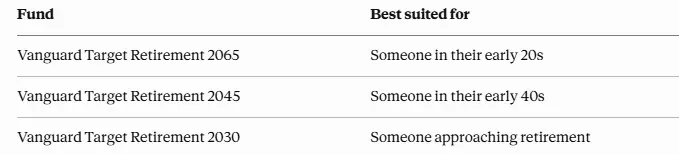
Target Retirement Funds (also called lifecycle funds) handle the entire journey automatically. You choose a fund based on when you plan to retire. When you are decades away, the fund holds mostly equities. As your retirement date approaches, it gradually shifts toward bonds and more stable assets — no intervention required.
The Vanguard Target Retirement fund range works exactly this way. You pick the fund closest to your planned retirement year and the allocation adjusts over time. Other major asset managers offer equivalent ranges — the logic is identical across providers.
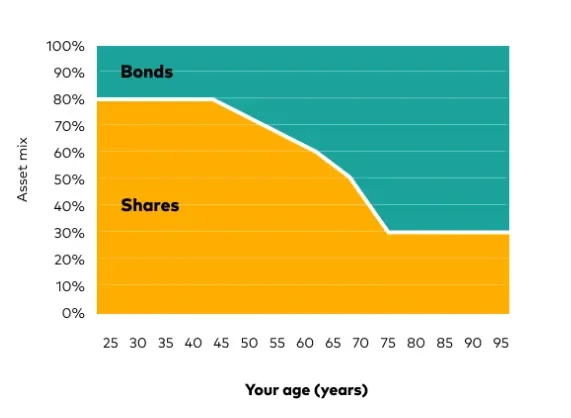
The Vanguard Target Retirement fund range works exactly this way. You pick the fund closest to your planned retirement year and the allocation adjusts over time. Other major asset managers offer equivalent ranges — the logic is identical across providers.
Ready-Made Pension Plans
If you would rather have professionals manage everything on your behalf, ready-made pension plans go a step further, experts handle not just the allocation, but the entire strategy, automatically adjusting as you age.
The trade-off is cost. You will pay a management fee for this convenience — typically charged as a percentage of your pot each year. The more your pot grows, the more you pay in absolute terms. For many people, the simplicity and peace of mind is worth it. For others, a low-cost DIY approach using index funds works out cheaper over the long run. Neither is wrong, it comes down to how hands-on you want to be.
A few examples worth being aware of:
Hargreaves Lansdown — their Ready-Made Pension Plan is professionally managed and automatically de-risks as you approach retirement, moving from growth-oriented investments early on to more stable assets closer to your target date
Moneybox — offers three funds (Adventurous, Balanced, and Cautious) aligned to your life stage. Younger customers are automatically placed into the higher-growth Adventurous option, shifting toward lower-risk funds as retirement draws closer
AJ Bell — similarly offers three ready-made options (Cautious, Balanced, and Adventurous), each professionally managed at a flat annual charge with no dealing fees
What About Your Workplace Pension Default? 🔎
Most people get auto-enrolled into a workplace pension default fund and never look at it again.
That default might be perfectly fine. Or it might be far too cautious for someone with 30 years until retirement, quietly leaving decades of potential growth on the table.
Log into your workplace pension and ask:
What fund am I currently in?
Is there a higher-growth option available?
Am I closer to a 1993 Snoop or a 2024 Snoop — and does my portfolio actually reflect that?
If a target date fund or ready-made plan is available through your provider, it may well be worth switching — especially if your current default has never been reviewed.
The Mistake Most People Make 🚨
Staying in the same fund forever.
Too aggressive in your 60s: one bad market year wipes out years of careful saving right before you need the money.
Too cautious in your 30s: you spend decades in bonds and cash when compound growth in equities could have done extraordinary things with that time.
The goal is not to pick the perfect fund once. It is to stay aware, stay intentional, and evolve as your circumstances change.
Snoop did not stay frozen in 1993. He moved with the times.
Your money deserves the same flexibility.
Final Thoughts 🙏
This is the final piece in our retirement series.
We started by understanding your options at retirement. We broke down annuities. We helped you find your number.
Now we end with the thing that ties it all together: the understanding that your portfolio is not a static object. It is a living strategy that should change as you change.
Early on, invest like Snoop in 1993. Bold. Growth-focused. Willing to absorb the hits because you have the time.
Later on, invest like Snoop in 2024. Strategic. Deliberate. Still very much in the game — just playing it smarter.
“There is a time for everything, and a season for every activity under the heavens.” — Ecclesiastes 3:1
Your money has seasons. Learn to read them.
Practical next steps:
Log into your workplace pension and check which fund you are invested in
Ask yourself: does my current allocation match where I am in life?
If you want automation, look at Target Retirement Funds — most major providers offer them
If you want your pension fully managed, ready-made pension plans are worth exploring
Review your allocation at least once a year — the same way Snoop checks the culture 🎤