Understanding covered-call, buffers and defined-return autocallable ETFs
There are more investment options available today than ever before.
From individual shares and bonds to alternative investments such as commodities, the growing range of options can make deciding where to put your money feel overwhelming.
But before choosing an investment, I think there’s a more important question we should ask ourselves.
What are you actually trying to achieve with your money?
Is your priority long-term growth? Generating income? Reducing the impact of market declines? Or perhaps achieving a more predictable investment outcome?
Two people can invest in the same market but have completely different goals for what they want their money to achieve.
With traditional equity investing, your returns generally follow the performance of the underlying market.
For example, if the S&P 500 rises by 10%, an ETF tracking it would typically deliver a similar return, before fees and other differences. If the market falls by 10%, your investment would generally decline too.
But what if your investment returns didn’t have to move in the same way as the market?
This brings me to an area of investing that I think deserves more attention.
Outcome-oriented investing.
These strategies use financial instruments, typically options, to change how an investment responds to different market conditions.
An option is a contract that gives its buyer the right, but not the obligation, to buy or sell an asset at an agreed price under specified conditions.
By combining options in different ways, investment managers can create strategies with particular return characteristics.
Importantly, a defined outcome doesn’t mean a guaranteed return. Your actual investment performance still depends on market conditions and the risks involved.
Let’s look at three approaches…
💰Covered-Call ETFs: Generating Income from Your Investments
Imagine you own shares in a company that you expect to perform reasonably well, but you don’t necessarily expect its share price to rise dramatically.
One way to generate additional income is through a covered-call strategy.
Here’s how it works.
You own the underlying shares and sell someone else the right to buy them at an agreed price, known as the strike price.
In exchange, you receive a payment called an option premium.
An example
Imagine you own shares worth £100.
You sell a call option with a strike price of £110 and receive a £3 premium.
Three possible outcomes:
The shares remain at £100: You retain the £3 premium, assuming the option expires without being exercised.
The shares rise to £120: Your gain is limited to £10 from the shares, plus the £3 premium. That’s £13 rather than the £20 you might have earned by simply holding the shares.
The shares fall to £80: You retain the £3 premium, but the shares have lost £20 in value, leaving you with a net loss of £17.
These examples exclude transaction costs, dividends and taxes.
The trade-off is straightforward: you receive an option premium in exchange for giving up some potential future gains.
Covered-call ETFs apply this concept across a portfolio, often using options linked to an equity index.
They may appeal to investors seeking regular distributions, particularly when markets are relatively flat or rising modestly.
However, these distributions aren’t guaranteed, and the strategy still carries substantial equity market risk.
For investors, the potential benefit is additional income. The cost is limited upside, while much of the downside risk remains.
🛡️ Buffer ETFs: Sacrificing Some Upside for Downside Protection
Now imagine your priority isn’t generating income.
Instead, you’re concerned about a potential market correction but still want exposure to equities.
This is where buffer ETFs come in.
A buffer ETF aims to absorb a specified portion of market losses over a defined period, in exchange for limiting how much you can gain.
For example, imagine an ETF offering:
A 15% downside buffer.
A 12% maximum gain.
A one-year outcome period.
If you invest £1,000 at the beginning of the period and hold until the end, your potential outcomes might look like this:
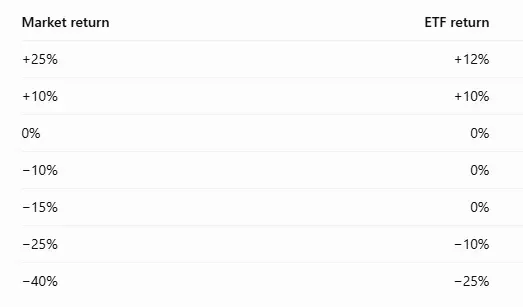
Simplified illustration before fees and other costs, assuming the buffer and cap apply at the beginning and end of the outcome period.
Notice what happens.
If the market falls by 10%, the buffer absorbs that decline.
But if the market falls by 25%, the investor bears the 10% loss beyond the initial 15% buffer.
And if the market rises by 25%, the investor only captures 12%.
You’re exchanging some potential gains in strong markets for a cushion against initial losses.
Importantly, a buffer ETF generally needs the underlying market to rise to deliver a positive return over its outcome period, before fees.
There’s also something investors need to understand about timing.
Buffer ETFs commonly have a one-year outcome period, with the advertised buffer and upside cap generally applying to investors who enter at the beginning and remain invested until the end.
If you purchase the ETF halfway through, your remaining upside and downside exposure may be very different.
For investors, the potential benefit is protection against an initial portion of market losses. The trade-off is capped upside and exposure to losses beyond the buffer.
🔄 3. Defined-Return Autocallable ETFs: When Markets Don’t Have to Rise
The third approach offers another way to generate equity-linked returns.
Defined-return autocallables aim to deliver a specified return when certain market conditions are met, even if the underlying market hasn’t risen.
An autocallable is linked to an underlying asset, often an equity index, and can automatically mature early when predetermined conditions are met.
An example
Imagine an autocallable linked to an equity index starting at 100, with:
A potential return of 8% per year, accumulating without compounding.
Annual observation dates, with early maturity if the index is at or above 100.
A maximum term of six years.
A final return threshold of 75 and a capital barrier of 65.
If the index reaches 105 at the first annual observation, the investment matures early and pays back the original capital plus 8%.
But if the index falls to 90, the investment continues.
If it subsequently recovers to 100 or above at an annual observation, it can mature early and pay the applicable accumulated return.
Now imagine it reaches the end of six years without being called.
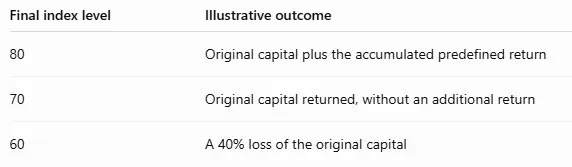
This hypothetical example assumes an 8% simple annual accrual, subject to the stated payment conditions. Actual autocallable structures vary.
The crucial distinction is that a capital barrier works differently from a buffer.
A buffer absorbs the first portion of losses.
A capital barrier provides conditional protection, but if the index finishes below it, investors may be exposed to the full decline from the initial level.
💡 Where Does the Return Come From?
You might wonder how an investment can generate a positive return when the underlying market hasn’t risen.
Autocallables use options and structured payoffs to offer predefined potential returns in exchange for accepting certain risks.
Investors generally give up unlimited equity upside and accept the possibility of significant losses if markets fall sharply.
Factors such as expected market volatility, the cost of downside protection and the investment’s duration influence the potential returns available.
The key trade-off is the opportunity to earn a predefined return, even in flat or moderately falling markets, in exchange for capped upside and exposure to significant losses in severe downturns.
❤️ Do You Actually Need These Strategies?
Not necessarily.
If you’re investing for the next 20 or 30 years, you might be perfectly comfortable holding a diversified portfolio of equities and accepting the ups and downs of the market.
But if you’re approaching retirement, looking to generate income or concerned about market downturns, some of these strategies may be worth exploring.
It’s encouraging to see more sophisticated investments becoming accessible to everyday investors, but each comes with its own costs, risks and trade-offs.
Ultimately, investing isn't about having the most complicated portfolio. It's about choosing investments that help you achieve your financial goals.