The power of faith, vision and building for the future.
Starting a business, in many ways, requires an extraordinary amount of faith.
Think about it.
Before a business has customers, generates revenue or even has a finished product, someone first has to see an opportunity worth pursuing.
They recognise a need, envision a solution and commit their time, money and resources to bringing that vision to life.
You’re building something today in anticipation of a future that isn’t guaranteed.
There’s a passage in Hebrews that I think captures this idea particularly well:
“Now faith is confidence in what we hope for and assurance about what we do not see.”
But faith isn’t simply about believing something will happen.
It also requires action.
And the story of Noah is a powerful illustration of that principle.
🛶 Noah: Building Before the Rain
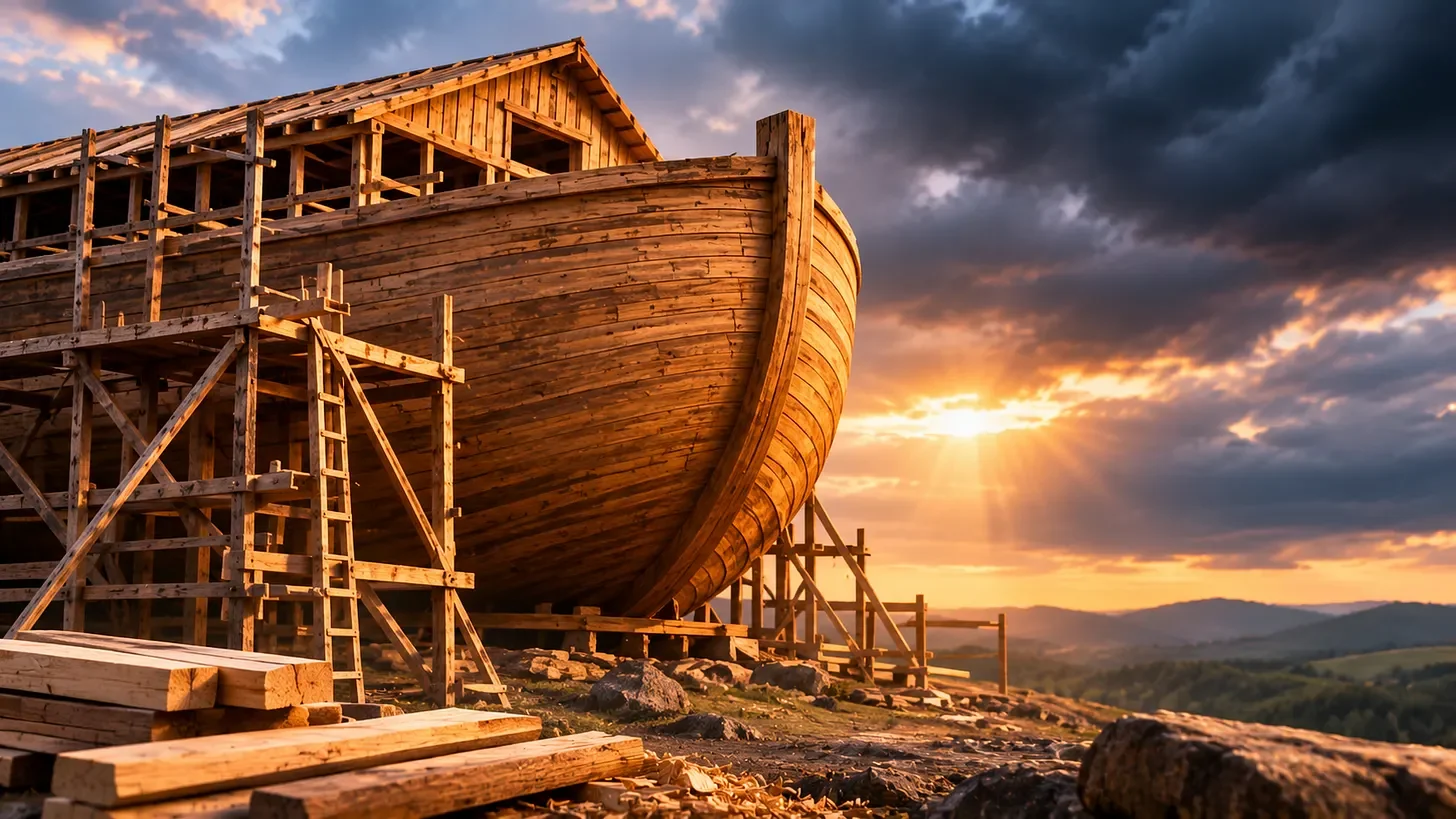
In Genesis 6, God warned Noah about a coming flood and instructed him to build an enormous ark to protect his family and living creatures.
Imagine being asked to construct something of that scale in preparation for an event that hadn’t yet happened.
Noah had to gather materials, follow detailed instructions and spend considerable time building.
He couldn’t wait for the rain to start before building the ark. By then, it would have been too late.
His faith required action. As James 2:17 reminds us, faith without works is dead.
And I think there’s an important lesson here about timing.
Sometimes, by the time everyone recognises the need for something, the greatest opportunity to prepare has already passed.
The same can be true in business.
By the time a new product or technology becomes widely accepted, some businesses may already have spent years developing their products, attracting customers and establishing themselves in the market.
But why do some people embrace new ideas long before others?
There’s a well-known theory that helps explain how innovations gain acceptance over time.
📈 Diffusion of Innovations Theory
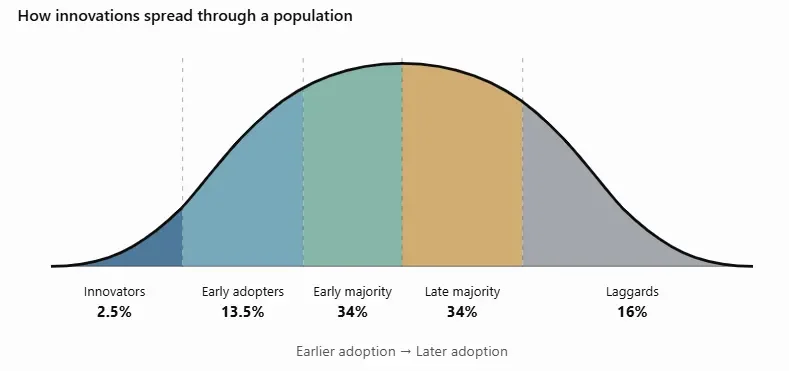
In 1962, sociologist Everett Rogers introduced the Diffusion of Innovations theory, which explains how new ideas and technologies spread through society.
His research showed that people don’t all adopt innovations at the same time.
Some are willing to experiment early, while others wait until a product has become widely accepted.
He identified five groups of adopters:
Innovators (2.5%) are the first to experiment with new ideas.
Early adopters (13.5%) recognise the potential of innovations before the wider market.
Early majority (34%) embrace products once their benefits become clearer.
Late majority (34%) tend to adopt once something becomes well established.
Laggards (16%) are generally the last to adopt, often preferring familiar ways of doing things.
Now, think about what this means for entrepreneurs.
By the time an opportunity becomes obvious to the wider market, early movers may already have established their products, customer relationships and competitive advantage.
That’s one reason recognising emerging trends can be so valuable.
But being early comes with uncertainty.
You don’t know how quickly customers will adopt your product, whether the market will develop as expected or whether competitors will offer something better.
The opportunity lies in recognising where demand could be heading, while managing the risks of getting there too early or backing the wrong idea.
And one of the clearest examples of this is the growth of artificial intelligence.
Just a few years ago, generative AI assistants were unfamiliar to most people.
Today, AI tools are increasingly used for a wide range of tasks, from writing and research to software development, data analysis and automating business processes.
But long before these products became mainstream, researchers and entrepreneurs were investing in the technology that would make them possible.
One of those businesses was Anthropic.
🤖 Anthropic: Seeing the Future Before the Crowd
If you haven’t heard of Anthropic, you may be familiar with Claude, its AI assistant and a competitor to ChatGPT and Google’s Gemini.
Anthropic was founded in 2021 by siblings Dario and Daniela Amodei and five other former OpenAI employees.
Dario had previously served as OpenAI’s vice-president of research, while Daniela held a senior leadership role overseeing safety and policy.
The founders believed there was an opportunity to develop powerful AI systems with a particular focus on safety and reliability.
And the timing is worth considering.
Anthropic was founded before ChatGPT was even launched to the public in November 2022.
The founders weren’t waiting for millions of people to start using AI assistants before recognising the opportunity.
They were building for a market they believed would become significantly larger.
But turning that vision into reality required more than recognising a trend.
It meant recruiting researchers, developing AI models, securing computing infrastructure and attracting investment.
Over the following years, Anthropic raised billions of dollars, launched its Claude models and developed products used by individuals and businesses.
And the opportunity continues to evolve.
We’re now seeing growing interest in agentic AI, where AI systems can go beyond generating responses to completing more complex tasks using tools and software.
For businesses developing these technologies, the potential market extends beyond people asking chatbots questions.
It includes organisations looking to automate workflows, improve productivity and change how work gets done.
💰 From a Startup to a Potential $1.4 Trillion IPO
Fast-forward to November 2026.
Anthropic is expected to make its stock market debut next week, with a potential valuation of approximately $1.4 trillion.
That’s an extraordinary potential milestone for a company founded just five years ago.
And it demonstrates how much investors believe the AI industry could grow.
Investors aren’t simply valuing what Anthropic has achieved. They’re also placing a value on what they believe it could become.
Of course, the company still faces intense competition, enormous infrastructure costs and the challenge of turning rapid growth into sustainable profits.
But that’s the nature of investing in the future. The potential rewards can be substantial, even though the outcome is uncertain.
What began as a vision in 2021 has developed into a business that investors may soon value at more than a trillion dollars.
❤️ What Are You Building Before the Rain?
I want to return to Noah.
He didn’t wait for the flood to arrive before preparing. He started building.
And I think there’s a lesson here that applies well beyond entrepreneurship.
You don’t need to see the full picture before taking the first step.
Perhaps you’ve been considering starting a business, changing careers, learning a new skill or pursuing an opportunity you’ve been putting off.
What’s holding you back?
Is it the fear of failure, uncertainty about the future or simply waiting for the perfect moment?
The reality is that you may never feel completely ready, and the perfect moment may never come.
But that doesn’t mean you should act recklessly. It means recognising that preparation and progress can happen even when the outcome is uncertain.
And remember, you don’t always need to reinvent the wheel. Sometimes the opportunity is simply finding a better way of doing something that already exists.
Whatever your ambition, don’t let the uncertainty of tomorrow stop you from making progress today.
Do your research, develop your skills, test your ideas and learn as you go. You don’t need to have all the answers before you begin.
For me, that’s where faith, vision and action come together.
Faith gives us the courage to believe in what’s possible. Vision helps us see what that future could look like. Research helps us understand how to get there. And action turns those possibilities into reality.
Some of the greatest opportunities come from seeing potential where others don’t and having the foresight to act before the rest of the world catches on.