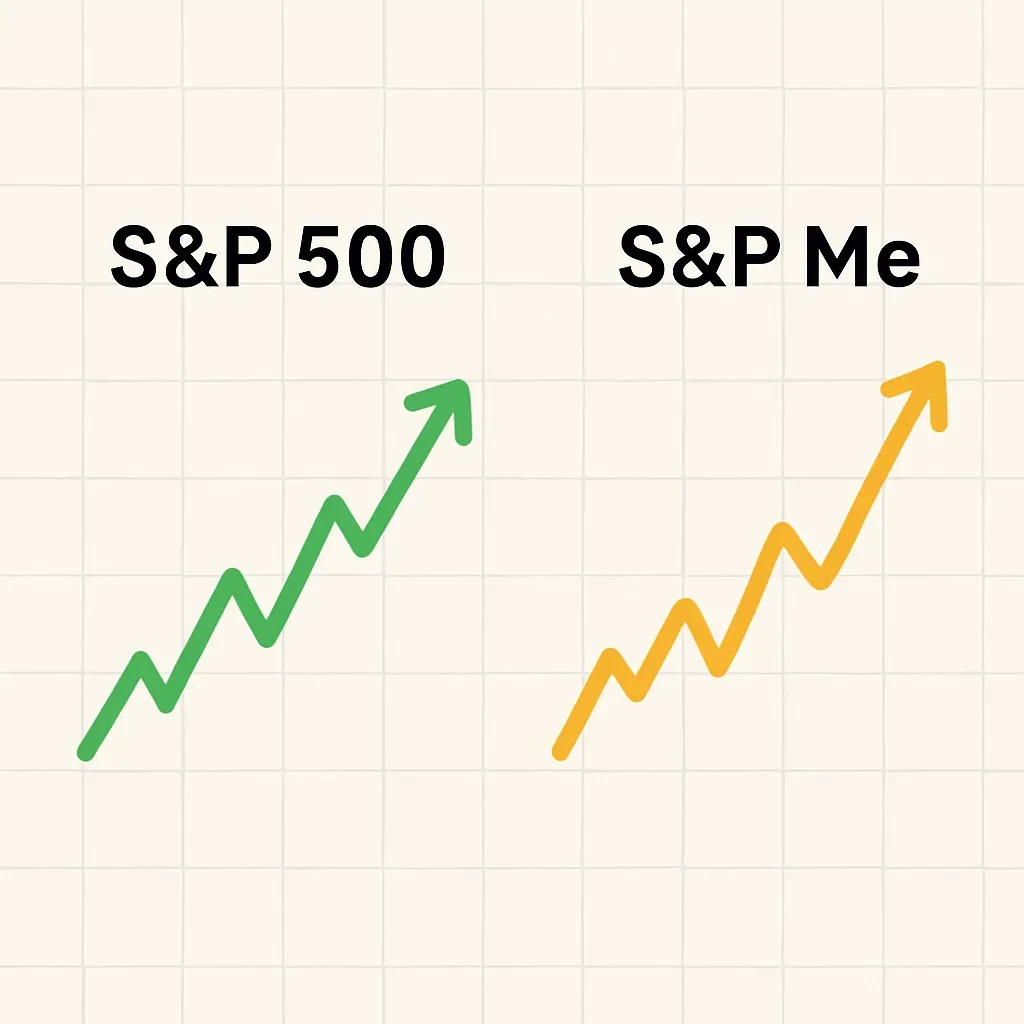
🚀 How to Always Beat the S&P 500
🧠 Understanding the S&P 500 and the mindset that helps you grow far beyond the market.
When people begin looking into investing, the first thing they often notice is how much information there is and how quickly it can get overwhelming.
There are so many opinions, so many voices, and so much terminology that it can be difficult to know where to begin.
But as people start to explore—through conversations, podcasts, online videos or reading—one name tends to appear again and again: the S&P 500.
It’s mentioned because it’s easy to relate to.
The S&P 500 is made up of companies most people already know—Apple, Amazon, Microsoft, Coca-Cola, Netflix, Nike, Visa.
When you recognise the names, the idea of investing becomes clearer: you’re simply owning small pieces of businesses you interact with every day.
📌 Where the S&P 500 Comes From
The S&P 500 has its roots in two long-standing research firms:
Standard Statistics Company (1906)
Poor’s Publishing (1800s)
They merged in 1941 to form Standard & Poor’s.
By 1957, the modern S&P 500 was launched — bringing together 500 major U.S. companies into one list.
Today, it represents:
around 80% of the U.S. stock market, and
nearly half of the global stock market’s value
This scale is why it’s referenced so widely. It captures a broad mix of the world’s most influential companies in one place.
📘 What an Index Actually Is
An index is simply a list that tracks how a group of companies is performing.
It is not a company, and it isn’t something you buy directly.
Here are a few well-known examples:
FTSE 100: largest companies in the UK
Nasdaq 100: major U.S. tech and innovation-led companies
Dow Jones: 30 long-established U.S. companies
MSCI World: companies across 23 developed countries
A single business can also appear in multiple lists at once if it meets the criteria.
For example, Apple is part of both the S&P 500 and the Nasdaq 100.
These lists simply help people understand different parts of the global market.
💼 How People Actually Invest in the S&P 500
You cannot buy the list itself.
But you can invest in funds designed to follow it:
ETFs
Index funds
Pension trackers
These funds mirror the S&P 500, which means:
One investment gives you exposure to all 500 companies at the same time.
And with fractional shares — where you can buy a small portion of a company instead of a full share — you can own a slice of these global businesses with relatively small amounts, even £50 at a time, for example, depending on the platform.
This is why the S&P 500 often appears early in someone’s investment journey: it shows how diversified investing works through a simple, accessible first step.
🔁 A Different Kind of Index: “S&P Me”
Understanding the S&P 500 shows you how companies grow, adapt, and respond to forces outside their control.
But there’s a deeper lesson sitting beneath the numbers.
There’s an idea I first heard from Alex Hormozi called “S&P Me.”
If an index is shaped by the companies inside it, then your life is shaped by the qualities inside you.
Your habits, decisions, skills and mindset all feed into your personal index.
Some areas are up.
Some are down.
And some need a completely new strategy.
If the S&P 500 is shaped by its companies, then your life is shaped by the “companies” within you — things like:
your skills
your habits
your discipline
your mindset
your emotional health
your relationships
your confidence
your decision-making
your character
your resilience
your faith
These are the factors that drive your performance over time.
These are the drivers of your long-term performance — the internal assets that determine your trajectory.
And here’s the key distinction:
📉 Markets move because of forces you cannot control.
📈 Your growth moves because of choices you can control.
🌱 Why Investing in Yourself Always Outperforms
The more you grow, the more every area of your financial life benefits.
A new skill becomes new income.
Better habits become better decisions.
Financial literacy becomes stability.
A stronger mindset becomes new opportunities.
Discipline becomes confidence.
Clarity becomes direction.
And unlike financial markets, these gains:
aren’t taxed
don’t lose value to inflation
don’t fall during a recession
don’t disappear because of global events
They compound — quietly, steadily, and permanently.
This is why the “S&P Me” comparison works so well: it takes something familiar (investing in the market) and shows you that you function like an asset too.
And the stronger you become, the stronger every investment decision you make becomes — whether it’s the S&P 500, property, business, or any other asset class.
🔚 Closing Thought
The S&P 500 tracks some of the most successful companies on earth.
But your life tracks something even more important: your capacity to grow, adapt, and elevate who you are.
Markets rise and fall.
But the investment you make in yourself pays dividends in every economic season.
So yes — learn the markets, invest consistently, build wealth wisely.
But never forget: