
Understanding Core & Satellite Investing🌍
You have started your investment journey, congratulations 👏
For many people, buying an S&P 500 ETF is their very first investment. And honestly, it is a great place to begin. With a single investment, you gain exposure to 500 of the largest companies in the United States such as Apple, Microsoft, Amazon, Nvidia, and Meta.
It is simple, low cost, diversified, and historically has delivered strong long term returns 📊
However, the S&P 500 is not the only way to invest in global equities.
Investors may also choose broader indices such as:
• MSCI World 🌎
• MSCI All Country World Index (ACWI) 🌍
• FTSE All World 🌐
• STOXX Europe 600 🇪🇺
• FTSE 100 🇬🇧
These indices can provide broader geographic diversification and exposure to companies outside the United States.
However, it is important to understand that many of these indices are weighted by market capitalisation. This means the largest companies and markets make up the biggest share of the index.
Market capitalisation simply refers to the total value of a company and is calculated by multiplying the share price by the number of shares outstanding.
Because the United States is home to many of the world’s largest companies, U.S. stocks still dominate many global indices 🇺🇸
The chart below highlights this clearly.
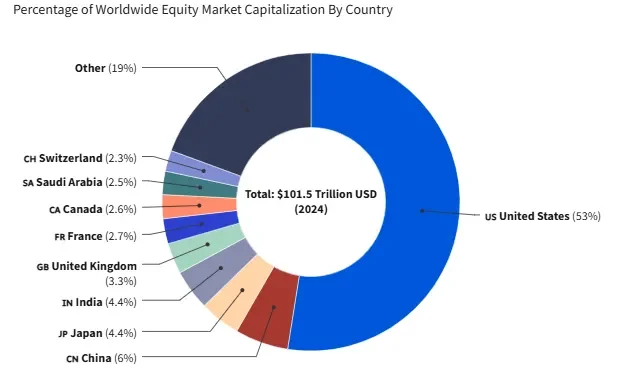
Source: World Federation of Exchanges (2024)
This is why understanding what you own matters just as much as investing itself 💡
Building Your Portfolio Like a Cake 🎂
Think of investing like baking a cake.
Every good cake starts with a strong base.
In investing, that base is often made up of broad global equities. Companies with global reach, strong balance sheets, scalable business models, and the ability to navigate different economic environments over time.
Professional investors often refer to this as your core portfolio 🏗️
Your core portfolio is designed to provide stability and long term growth. It usually represents the majority of your investments and is often invested passively, meaning you are tracking an index rather than trying to outperform the market.
This approach is typically low cost, highly diversified, and built for the long term ⏳
In finance, this market exposure is often referred to as beta.
Beta measures how sensitive an investment is relative to the broader market. A portfolio closely tracking the S&P 500 will usually have a beta close to 1, meaning it broadly moves in line with the market itself.
There is no perfect rule, but for many investors, a core portfolio may represent around 70–90% of their total investments depending on their goals, age, and risk tolerance.
The Satellite Portfolio: Where Views Become Convictions 🛰️
The remaining portion of a portfolio, perhaps 10–30%, is often called the satellite portfolio.
This is where investors take a more active approach and express specific views on the market.
Satellite investments can take many different forms, including:
• Thematic investing 🎯
• Emerging markets 🌏
• Individual stocks 📈
• Commodities such as gold, silver, copper etc⛏️
• Small cap companies 🏢
• Sector investing (such as technology, healthcare, or energy ⚡)
• Private markets such as private equity, infrastructure, and private credit 🏙️
• Cryptocurrency and digital assets ₿
This part of the portfolio is generally more active and carries higher risk.
Unlike a passive core portfolio that aims to track the market, satellite investments are often designed to outperform the market.
In finance, this additional return investors aim to generate above the market is known as alpha.
If beta is simply following the market, alpha is attempting to beat it 🚀
For example, if the broader market returns 8% but your investment strategy returns 12%, the additional return generated above the market can be considered alpha.
Of course, the opposite can also happen.
You may outperform the market.
You may also underperform it.
Again..this is why diversification, risk management, and time horizon remain critical when investing ⚖️
The key point is this:
Your core portfolio builds stability 🧱
Your satellite portfolio expresses conviction 🎯
Why Thematic Investing Has Become So Popular 🔍
Among these satellite approaches, thematic investing has become one of the fastest growing areas of investing, particularly among younger investors.
Rather than investing by country or sector alone, thematic investing focuses on long term global trends expected to shape the future economy and society.
Examples include:
• Artificial Intelligence 🤖
• Cybersecurity 🔐
• Robotics ⚙️
• Clean Energy 🌱
• Nuclear and Uranium ☢️
• Digital Payments 💳
• Cloud Computing ☁️
• Ageing Populations 👵
• Blockchain Technology ⛓️
The idea is simple: identify powerful structural trends early and invest in the companies likely to benefit from them over the long term.
Some themes become transformational. Others fail to live up to expectations.
That is why thematic investing should usually complement a strong core portfolio, not replace it.
This article is the beginning of a series exploring investing beyond traditional global equities. While broad market investing remains one of the best starting points for many investors, understanding how to build around that foundation can help you create a portfolio that better reflects your goals, interests, and convictions.
Next week, I will explore thematic investing in more detail, including how themes are identified, why they have grown so rapidly, and the risks investors should understand before investing in them 🧠
Because investing is not just about buying the market.
It is about understanding it 💭