
Why the Iran war affects your wallet and what you can do about it
What’s happening in the Middle East right now is evolving quickly.
But there is a more practical question.
What does this actually mean for your everyday life and your money?
To understand that, it helps to look at three things. History, geography and how the global economy works.
A conflict shaped over time
Tensions involving Iran and Israel did not begin recently.
They have developed over decades, particularly since Iran’s 1979 revolution.
But to understand the tension, you have to look further back.
Iran and Israel sit in a region that is home to some of the world’s oldest civilisations, and has been a crossroads of trade, culture and power for centuries.
Today’s tensions are shaped by current political pressures but sit on top of long-standing regional rivalries. Major global players, including the U.S., are also closely involved, which is why this conflict has implications far beyond the region.
That helps explain why tensions here often run deeper and are harder to resolve.
Why this region matters today 🌍
At the centre of this story is a narrow shipping route called the Strait of Hormuz.
It connects oil-producing countries in the Gulf to the rest of the world.
Under normal conditions, around 20 million barrels of oil pass through it every day. That is roughly one in every five barrels globally.
It is also a key route for natural gas and materials used to produce things like food, plastics and electronics.
It affects how energy moves around the world, and that is what markets react to.
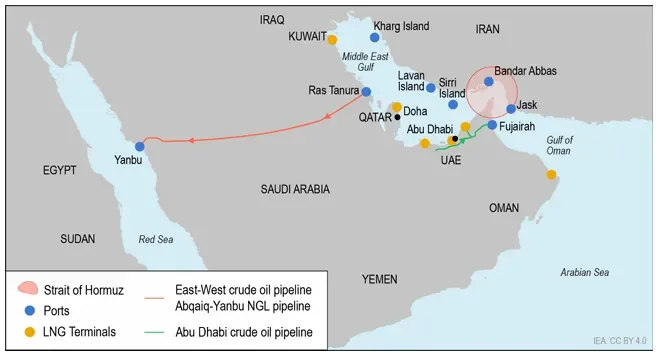
IEA Strait of Hormuz 2026
What has changed
Because of the conflict, this route has become harder to use.
Ships face higher risks, higher insurance costs and delays. This reduces how much energy can move freely around the world.
When supply becomes less certain, prices respond.
A useful way to track this is through oil prices.
Oil is traded globally using benchmark prices, and one of the most important is called Brent crude. It acts as a reference point for much of the world’s oil.
Recently, Brent has moved back above 100 dollars per barrel, after trading closer to 75 to 85 dollars before the conflict.
That gives a clear signal. Markets are pricing in disruption.
How this shows up in everyday life
If oil prices stay higher, you are likely to see it in:
Petrol and diesel prices ⛽
Food costs 🛒
Flights and travel ✈️
Everyday goods
For example, if filling your car costs around £60 today, sustained higher oil prices could push that closer to £70 or £75 over time.
When energy costs rise:
Transport becomes more expensive, increasing the cost of moving goods
Farming becomes more expensive, raising food prices
Manufacturing becomes more expensive, pushing up the cost of products
Businesses pass many of these costs on.
That is how higher energy prices feed into broader inflation and everyday expenses.
What this means for interest rates and mortgages 📉
Higher energy costs can push inflation up.
When inflation stays high, central banks are less able to cut interest rates.
That can keep borrowing costs higher across the economy.
For example:
Mortgage rates can stay higher for longer 🏠
Some lenders may pull deals as markets become more volatile
Monthly repayments can increase or remain elevated
We are already seeing signs of this, with some mortgage products being withdrawn as markets adjust.
This is how global events can directly affect household finances.
What kind of environment does this create 🌍
If this continues, it can lead to a situation where prices remain high while economic growth slows.
This is known as stagflation, when prices stay high but growth slows at the same time.
The key question is not just what has happened, but how long it lasts.
Short disruptions tend to fade. Longer ones reshape prices, policy and markets.
It is also worth remembering that energy markets do adjust over time. Countries hold reserves, alternative supply routes can be used, and higher prices tend to encourage more production.
But that adjustment does not happen instantly.
Why some regions are hit harder 🌐
The impact is not evenly distributed, and this is where global dependence becomes clear.
Many economies in Asia rely heavily on energy imports from the Middle East. Around 70–80% of the oil that passes through the Strait of Hormuz is destined for Asian markets, particularly countries like China, India, Japan and South Korea.
This means disruptions are often felt there first through higher costs and economic pressure. Europe and the UK are also exposed. Their reliance on imported energy means global price increases can quickly feed into inflation and household bills.
Some countries are better positioned due to more diverse energy sources or stronger reserves.
What can you do about it 🧠
You can’t control global events.
But you can control how you respond.
Watch your key costs
Keep an eye on fuel, food and mortgage or rent. These are usually hit first.Expect things to stay expensive for a while
When inflation is driven by energy, it can take longer to come down.Don’t rely on one source
Whether it’s your income or investments, spreading risk matters more in uncertain times.Avoid reacting to every headline
Markets move quickly, but good decisions are usually long-term.
The bigger picture 🧩
This isn’t just about one conflict.
It’s a reminder of how connected everything is.
Events in one part of the world can quickly affect prices, interest rates and your finances.
It also shows why paying attention to the bigger picture matters.
Geopolitical events don’t stay in the news. They show up in prices, and eventually in your everyday life.
So how do you prepare?
Stay diversified 📊
Keep a long-term mindset
Build a buffer where you can
You don’t need to predict every event.
You just need to be prepared for change.