Two Big Labour Announcements You Should Know 💷🏠
The Labour Party is holding its annual conference, bringing together politicians, party members, unions, businesses and other organisations to debate policy, hear from the party leadership and discuss the government’s priorities.
And this year’s conference feels particularly significant.
It is Andy Burnham’s first as Prime Minister, and it comes just weeks before the Autumn Budget on 28 October.
That timing matters. The conference gives us an early look at the government’s priorities, while the Budget will tell us much more about what those plans will cost and where the money will come from.
For me, two announcements in particular caught my attention.
Changes to the State Pension triple lock.
And new help for first-time buyers.
Let’s get into it.
What Is the Triple Lock? 🔒
The State Pension triple lock was introduced by the Conservative-Liberal Democrat coalition in the early 2010s.
The concept is simple.
Each year, the State Pension increases by whichever is highest:
Inflation
Average earnings growth
2.5%
Inflation protection helps stop rising prices eroding what pensioners can afford.
The earnings element means that as wages rise over the long term, pensioners don’t gradually get left behind.
And 2.5% provides a minimum increase when both are low.
From April 2026, the full new State Pension increased to £241.30 a week, or around £12,548 a year.
And here’s where it gets interesting.
The State Pension is taxable income.
The standard Personal Allowance is currently £12,570, meaning the full new State Pension now uses almost your entire tax-free allowance.
And while the State Pension continues to rise, the Personal Allowance is currently frozen at £12,570 until 2030/31.
So if you receive the full new State Pension alongside a workplace or private pension, some of your retirement income could be subject to Income Tax.
Yes, you can pay Income Tax in retirement.
So Why Change the Triple Lock?
The problem is that inflation and wages don’t always move together.
Pensions might receive a large increase when inflation jumps. Wages can then catch up later, potentially triggering another large increase.
Those increases become the new starting point for future increases.
Over time, that gets expensive.
In fact, the OBR says the triple lock has cost around three times more than originally expected, largely because inflation has been more volatile and earnings growth lower than anticipated.
By 2029–30, it estimates the triple lock will be adding £15.5 billion a year to State Pension spending compared with simply increasing pensions in line with earnings.
And remember, that £15.5 billion is not the total State Pension bill. It is the additional annual cost of the triple lock.
Add an ageing population, and you can see the challenge:
How do we continue protecting pensioners while keeping the State Pension sustainable for future generations?
What Is Labour Changing?
From 2030–31, Labour plans to change how the triple lock works.
Inflation protection stays. The 2.5% minimum stays. And pensions will still be protected from falling behind average earnings over time.
What changes is that when pensions temporarily grow faster than wages, that advantage doesn’t have to be carried forward forever.
The IFS chart below shows this much better than I can.
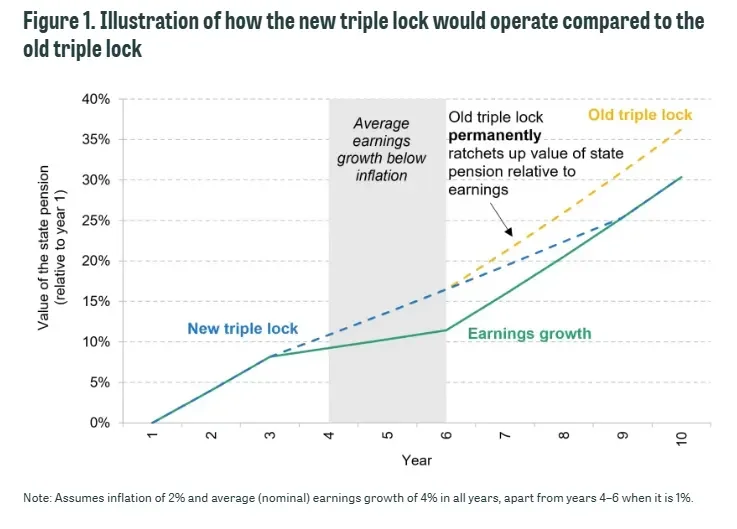
Source: Institute for Fiscal Studies. Illustration, not a forecast.
During the grey period, wages grow more slowly than inflation, so the State Pension moves ahead of earnings.
Under the old triple lock, that gap is permanently carried forward. Under the new system, pensions remain protected, but earnings are allowed to catch up.
The IFS estimates that if the new system had operated between 2010 and 2026, the government would have spent around £9 billion less on the State Pension in 2026–27, while pensions would still have grown faster than the cost of living.
The aim is simple: protect pensioners while making the long-term cost more sustainable.
Where Will the Savings Go?
The government expects the changes to eventually save around £15 billion a year by 2040.
Those savings are intended to help fund another conference announcement: a proposed National Care Service, including free personal care for older people.
But 2040 matters. The savings build gradually and won’t cover the entire cost of a National Care Service.
And for our own finances, there is a lesson here too.
Rules change.
The State Pension should be part of your retirement plan, not your entire retirement plan.
What About First-Time Buyers? 🏠
The second announcement sits at almost the opposite end of our financial lives.
Buying your first home.
The government has announced a new scheme called Your First Home, aimed at people who could potentially afford the ongoing cost of homeownership but are struggling to build the deposit.
Particularly those without access to the Bank of Mum and Dad.
The proposal looks like this:
2.5% deposit
20% government-backed equity loan
77.5% mortgage
This isn’t the government giving you 20% of the house for free.
The government provides 20% of the purchase price, which you will eventually have to repay. Unlike a normal loan, what you repay may be linked to the value of your home.
Take a £300,000 new-build.
Your 2.5% deposit would be:
£7,500
The 20% government equity loan would be:
£60,000
And your mortgage would cover the remaining:
£232,500
Compare that with finding a £30,000 deposit for a traditional 90% mortgage and you can immediately see the attraction.
But before getting excited about the £7,500 deposit, there are some important questions we still don’t have answers to.
When do you start paying for the equity loan?
How long is the interest-free period?
What interest rate applies afterwards?
And if your home increases in value, does the amount you eventually repay increase too?
The government says there will be an initial interest-free period, although we don’t yet know how long it will last.
And those details matter because a smaller deposit doesn’t necessarily mean a cheaper way to buy a home.
Don’t Just Look at the Deposit 🔍
I would tell any first-time buyer considering the scheme…
Don’t just ask how much you need to get in. Ask what it will cost you overall.
A 2.5% deposit makes it easier to buy the property.
It doesn’t necessarily make the property cheaper to own.
The scheme will also only apply to new-build homes from participating developers.
And this is important because the policy is trying to achieve two things.
Help first-time buyers.
And support the new-build housing market.
That isn’t necessarily a bad thing. Britain needs more homes.
But it does mean buyers aren’t the only potential beneficiaries. Developers benefit from having more people able to purchase their properties too.
If the scheme increases the number of people able to buy, but we don’t build enough additional homes, some of that government support could simply push house prices higher.
So I would compare:
The property price.
Your mortgage repayments.
Any service charges.
The cost of the equity loan.
What happens if the property increases or falls in value.
And what you will eventually need to repay.
Do You Actually Need the Scheme?
This is probably the first question I would ask.
If your biggest barrier is the deposit, and you genuinely cannot buy without additional help, Your First Home could potentially open a door that was previously closed.
But if you can afford to buy a suitable property through the normal mortgage market, I would compare that carefully before taking an additional government equity loan and restricting yourself to participating new-build properties.
Sometimes the simpler option gives you more flexibility.
Take the Lifetime ISA.
If you’re eligible, you can currently save up to £4,000 a year and receive a 25% government bonus, worth up to £1,000 each year.
You don’t have to repay that bonus when you buy your home, provided you follow the LISA rules.
That’s very different from the new scheme, where the government’s 20% contribution will eventually need to be repaid.
So if you’re able to build a sufficient deposit using your own savings, a LISA and a traditional mortgage, it’s worth comparing that route before taking on an additional government loan.
There are also alternatives such as Shared Ownership and the existing First Homes scheme.
The point isn’t that one scheme will always be better.
It is this:
Government support should solve a problem you actually have.
Don’t take on additional complexity simply because it is available.
Conference Is the Trailer. The Budget Is the Film. 🎬
That is probably my biggest takeaway from Liverpool.
We’ve heard the announcements. Now I want to see the numbers.
The Autumn Budget on 28 October should give us much more detail on how the new first-time buyer scheme will work and how the government intends to fund its wider ambitions.
Because whether it’s your pension or your first home:
The headline gets your attention.
The numbers tell you what it means for your money.