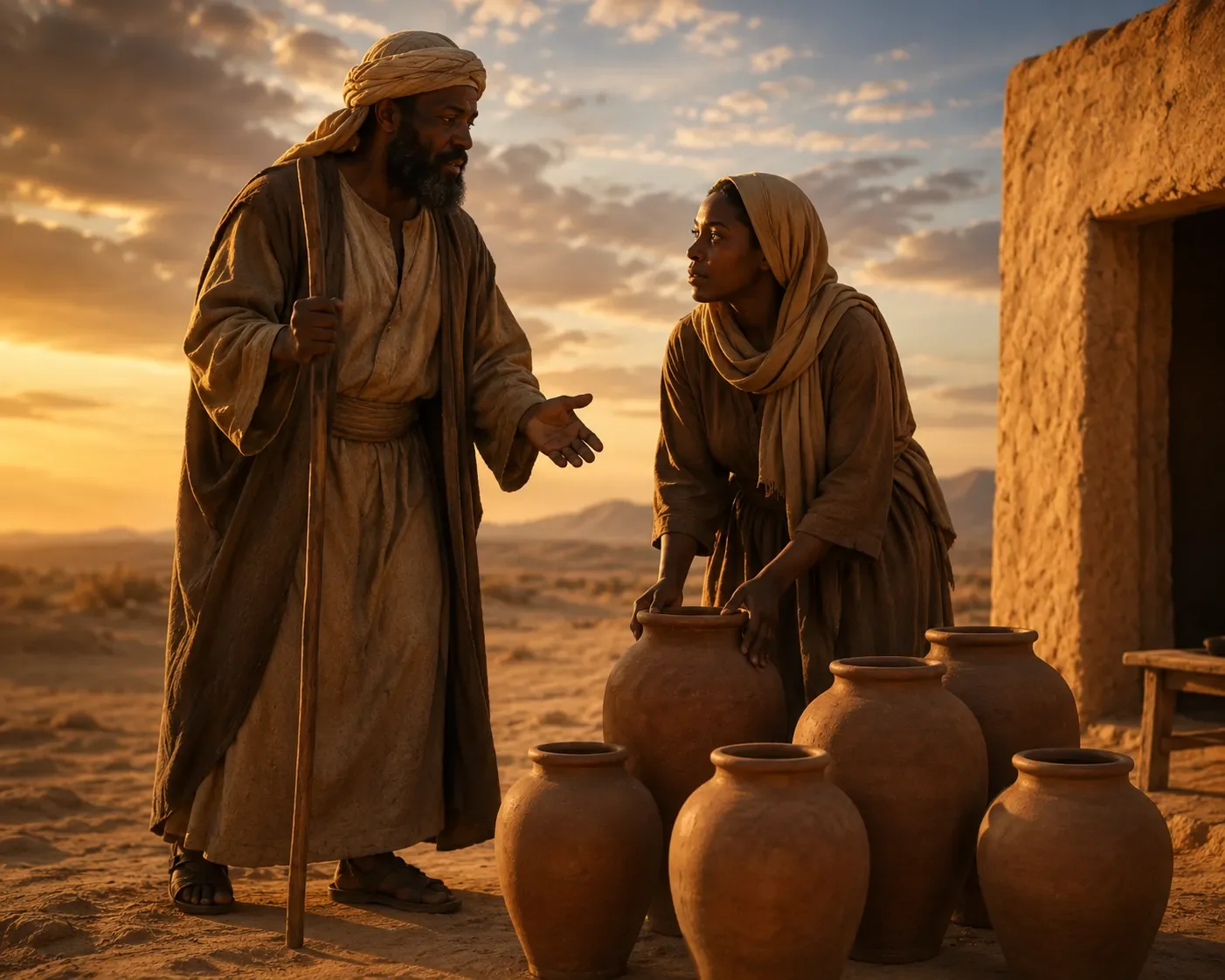
What do you do when your husband dies and leaves behind debt so severe that creditors are coming to take your sons as slaves?
That's not a hypothetical. That's the opening of 2 Kings 4:1–7, written thousands of years ago, and still just as relevant today.
Picture the Scene
A woman has just lost her husband. She barely has time to grieve. Before the dust settles, there’s a knock at the door. Creditors. And they’re not just asking for money. In that era and culture, unpaid debts could be settled by labour. Her sons could be legally taken to work off what was owed. Not a threat. A legal reality. She has almost nothing in the house, no plan, and she’s running out of time.
She goes to the one person she can think of.. Elisha. Not just a community elder or a wise man in the neighbourhood. Elisha was one of the most significant prophets of his time, known and respected across the nation. She knew exactly who she was going to. And she puts everything on the table.
Even Good People Can Die in Debt 💸
Before we go further, there's something worth pausing on. Her husband was a prophet himself, part of the same community as Elisha and well-regarded within it. This was someone with a genuine, recognised relationship with God. And he died in debt.
The Bible says in Deuteronomy 8:18 that God gives us the power to get wealth. But power still has to be developed into skill. You can love God deeply and still be a beginner when it comes to managing money. Spiritual depth and financial wisdom are both things that grow, and both need to be deliberately pursued. They don't automatically come together. God cares about your financial life. This story exists, in part, because He does. And what happens next is worth paying close attention to.
Elisha Asks a Better Question
She comes to Elisha and lays out her situation. Her husband is gone. The debt is real. The creditors are coming.
His response: “How can I help you? Tell me, what do you have in your house?”
She came with a problem. He responded with a question about what she has.
That shift matters. When we are under financial pressure, our instinct is to describe the problem. And describing it rarely moves it. What moves things is asking a better question. Not “why is this happening to me?” but “what do I have to work with right now?” Choosing to look at what is there rather than what is missing genuinely changes what you can see. An attitude of gratitude is not just a positive mindset exercise. It opens your eyes to resources you have already been given but stopped noticing.
This is the same principle at work when Jesus feeds five thousand people with five loaves of bread and two fish. The disciples were focused on the shortage. Jesus asked what they had, gave thanks for it, and then multiplied it. Not conjured from nothing. Multiplied from what was already there. The pattern is consistent: bring what you have, acknowledge it, and watch what God does with it.
She Almost Missed It 👀
The widow answers Elisha: “Your servant has nothing there at all, except a small jar of olive oil.”
Read that again.
She said she had nothing, and then told him exactly what she had in the same breath.
It’s so easy to do this. When your need feels enormous, what you have can feel like it doesn’t count. A small jar of oil next to a mountain of debt looks like a rounding error, not a resource. But Elisha doesn’t ask her to solve the whole problem. He asks what she has. And she has something.
In Scripture, oil is often used as a symbol of God’s anointing: His power working through you to do what you could not do by effort alone. So what she is holding is not just a product. It is a picture of what God places in our hands. Something that looks small, but carries the capacity to multiply when it is acknowledged and brought to Him. Your jar of oil might be a skill, a service, an idea, time, or a relationship you have not fully explored. The first step is simply to see it for what it actually is.
Don’t Ask for Just a Few
Elisha tells her: “Go around and ask all your neighbours for empty jars. Don’t ask for just a few.”
Then go inside, shut the door, and pour.
She does not receive money. She receives a process, and a test embedded within it: how many jars will she go and get?
She pours. The oil keeps flowing. Every jar she brought fills to the brim, one after another. And then she asks her son for another, and he tells her: “There is not a jar left.”
And the oil stops.
Not because God ran out. It stopped because she ran out of containers. And that is the point. Her success was in direct proportion to her faith. Not faith as a feeling, but faith made visible in action. The more jars she gathered, the more she received. The limit was not God’s supply. The limit was hers.
Elisha had told her explicitly: don’t ask for just a few. That was the whole instruction. Luke 6:38 says: “Give, and it will be given to you. A good measure, pressed down, shaken together and running over, will be poured into your lap. For with the measure you use, it will be measured to you.” The measure you use. She determined the measure by how many jars she was willing to go and get.
The Vehicle You Choose Matters ✈️
People talk about the windows of heaven opening over their finances. But if it is raining and you show up with a small cup, the rain is not the problem. The cup is. The size of your container determines what you can catch.
Think about it another way. If you are trying to get from London to Paris, you could walk, swim, drive, or fly. You will get there eventually with any of them. But the vehicle changes everything: how fast, how much you can carry, how far the next move can take you.
The oil in this story is the resource. The jars are the vehicle. And the size and number of those jars determined what she could do with what she had.
This applies directly to how we build our financial lives. The career you are in, the business you are building, the income structure you have set up: these are your containers. They are not the source of provision, but they determine what you can hold. A vehicle with a hard ceiling, one that cannot scale or grow, is a small jar. Not wrong, but worth examining honestly. If you are expecting more, it is worth asking whether your container is sized for it.
She Didn’t Wait for a Bailout
When the widow reports back to Elisha, he tells her: “Go, sell the oil and pay your debts. You and your sons can live on what is left.”
She did not just survive. She came out ahead.
Elisha did not give her money. He did not call the creditors. He pointed her toward an opportunity that required her to act, to take what she had, bring it to people who needed it, solve a real problem, and get paid for it. One of the most effective ways to get out of debt is to increase your income. And one of the most reliable ways to increase your income is to find a problem people have and solve it. The thing that gets you out of debt might already be sitting in your house. A skill. A service. Something you are good at that other people genuinely need. She was sitting on a jar of oil and nearly wrote it off as nothing. It turned out to be everything.
What’s in Your House? 🏠
If you are in a season of financial pressure right now, here are the questions worth sitting with:
What do you actually have? Set aside what you owe and what you feel is missing. Skills, relationships, time, ideas, experience: what is really there? What have you been dismissing as too small to matter?
Are you asking better questions? Are you spending more energy describing the problem than looking at what you have to work with?
How big are your containers? Does your current career or income structure have room to grow? Is the vehicle you are in capable of taking you where you are trying to go?
Are you acting, or just hoping? The widow’s faith showed up in how many jars she gathered, before the outcome was visible. What would acting in faith look like for you right now?
What problem could you solve for someone else? The solution to clearing your debt might already be in your house. What can you offer that someone genuinely needs?
Next Wednesday I am sharing practical strategies for clearing debt. But before then, hold the full picture of this woman’s story. She started with grief, debt, and her sons’ freedom on the line. She walked out debt-free with money to spare. Not because someone rescued her. Because she looked at what she had, built her faith into action, and made room for more than she thought was possible.
Your story might start the same way. With one small thing in your house that you have been overlooking.