
Pay Off Debt or Start Investing? Here's How to Actually Think About It
Get the order wrong and the numbers work against you
On Sunday I explored what the Bible actually says about debt. It was also the first Sunday edition of Money Matters, so I would love to hear what you think of that format. Check it out here. Today we tackle a question that comes up constantly: should you clear your debt first, or start investing?
One thing before we go further 🛟
Before the question of debt versus investing even becomes relevant, one thing needs to be in place: an emergency fund. If you have no financial buffer and something unexpected happens, you go straight back into debt. Start with a mini emergency fund of £500 to £1,000. Dave Ramsey calls this the baby emergency fund. Not a fully funded one, just enough to break the cycle.
Once you are in a stronger position, build it to three to six months of living expenses, ideally in a high-interest cash ISA. With rates currently around 4%, your money grows while it sits there, which is far better than leaving it in a current account earning next to nothing. Now, with that foundation in place, let us look at the real question.
Not all debt is the same
Debt is essentially borrowing from your future to pay for your present. That can be powerful or destructive depending on what you are borrowing for and at what cost.
A mortgage builds an asset. A business loan can generate returns far beyond what you borrowed. Even a personal loan, used to fund a car you need for work or a home renovation that increases the value of your property, can make financial sense if the numbers stack up. These forms of debt, managed carefully, can work in your favour.
But debt used to fund consumption, spending that leaves nothing behind, is a different story. And even so-called good debt becomes a problem the moment you can no longer service it. The type of debt you are carrying, and what it is costing you, is where the answer to our question lives.
The benchmark: what does investing actually return? 📈
Before looking at the cost of different types of debt, you need something to measure against. The question we are really asking is: is paying down this debt a better use of my money than investing it?
The S&P 500 is a commonly referenced benchmark in investing, tracking the 500 largest companies in the United States. Over the last 10 years it has returned an annualised 11.78%, and over the longer run, going back 50 to 100 years, the figure sits at around 10 to 11% per year. That is the return most long-term investors use as a guide when planning for the future.
This will be our measuring stick. Now let’s look at what different types of debt actually cost and how they compare.
The cost of borrowing: three comparisons
The cost of borrowing in any economy starts with the central bank. In the UK, the Bank of England sets the base rate, currently held at 3.75%, which is the rate at which commercial banks borrow from it. This acts as a benchmark for the cost of borrowing across the wider economy. Central banks have a number of functions, but this is one of the most consequential for everyday finances. The US Federal Reserve and the European Central Bank serve the same role in their respective economies. But the base rate is just the floor. What you actually pay depends entirely on the type of debt you are carrying.
Credit cards 💳
The average credit card APR in the UK is currently 24 to 36%, the highest in over 30 years. These are unsecured debts, meaning the lender has no collateral. The consequence of not paying is not that they take your possessions. It is that your credit score suffers and compound interest builds faster than almost anything in the market can outpace. A £5,000 balance at 25% costs you £1,250 in interest in a single year. If you are only making minimum payments, that debt can take over a decade to clear.
Measured against the benchmark: credit card interest at 24 to 36% sits far above the long-run market return of around 10 to 11%. There is no investment case for carrying this debt.
Personal loans 🏦
A personal loan sits in a different category. Rates typically range from around 5 to 15% APR depending on the lender and your credit profile. People use them for all kinds of things: buying a car, funding a home renovation that can increase the value of your property, or consolidating multiple credit card balances at a lower rate. Borrowing at 8% to clear what was costing you 25% is often one of the smartest moves available.
Measured against the benchmark: a personal loan at 5 to 8% starts to look competitive with long-run market returns. This is where the conversation about doing both, paying down debt and investing at the same time, starts to become real.
Mortgages 🏠
A mortgage is the most common form of significant debt most people carry. It is secured against your property, long-term, and priced accordingly. The average 2-year fixed rate in the UK currently sits around 5.09 to 5.63%.
Measured against the benchmark: if your mortgage is costing you 5 to 6% and the market has historically returned around 10 to 11%, the maths points toward investing your surplus rather than overpaying. But two things complicate that. First, most mortgages cap overpayments at 10% of the outstanding balance per year. Exceed that and you face early repayment charges, so check your terms before acting. Second, this is personal finance, not a maths test. Being mortgage-free carries real psychological value, and most retirement planning assumes you will not still be servicing a mortgage in your 60s. Never dismiss the value of certainty.
So: invest or pay down debt?
High-interest debt: clear it first. Paying off a credit card charging 25% is a guaranteed, realised return of 25% on your money. You will not find that in any market with any certainty. More than that, it is buying your future back. Every month that balance sits, you are paying for something you already spent. Treat it like the financial emergency it is.
Lower-interest debt: consider doing both. If your debt is a personal loan at 8% or a mortgage at 5 to 6%, and you can comfortably meet every repayment, there is a genuine case for investing alongside paying it down. Time in the market matters. Someone who starts investing at 25 rather than 35 does not just get 10 more years of contributions. They get 10 more years of compounding on everything that came before.
The word is comfortably. Investing should never put you at risk of missing a repayment.
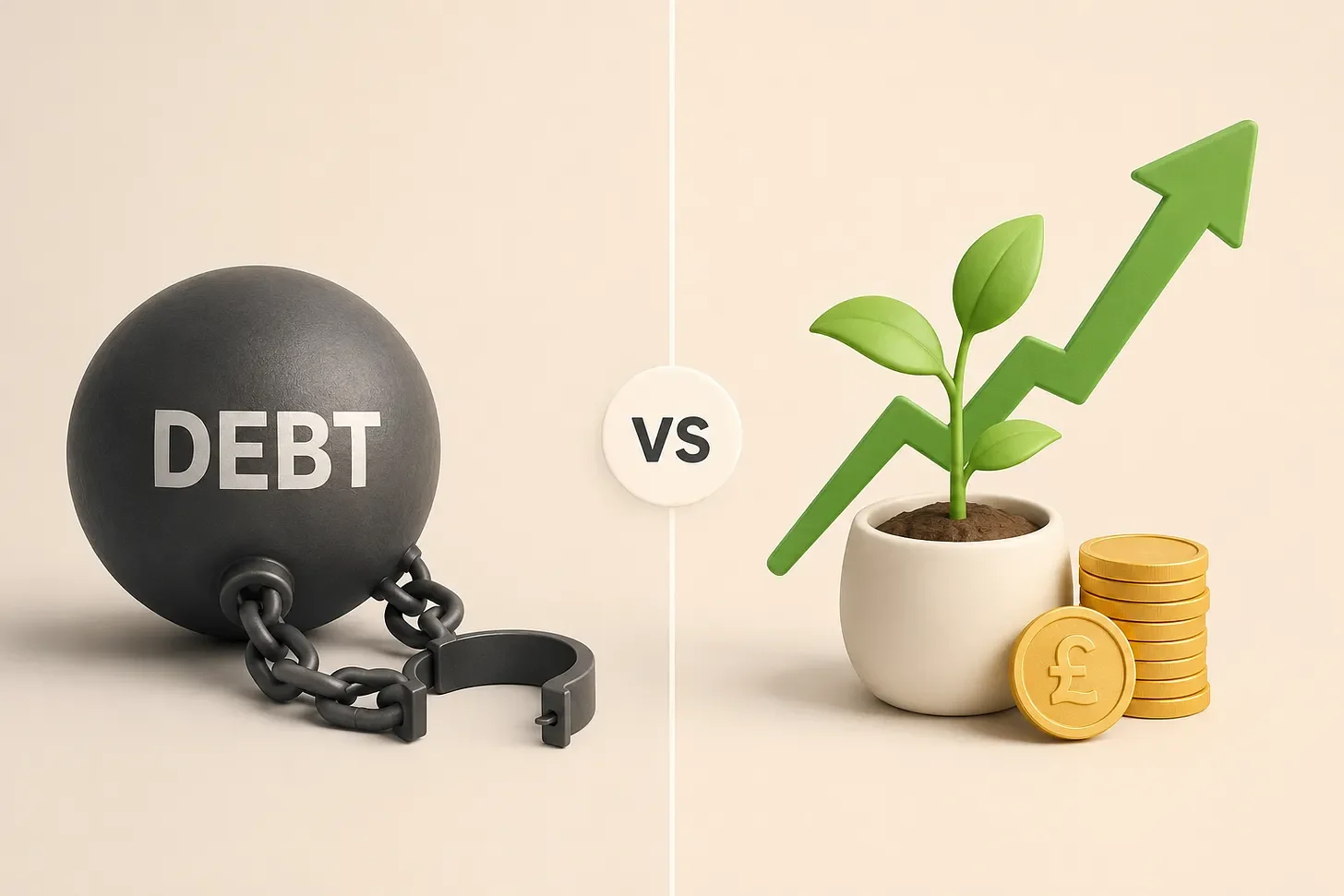
Debt, like most things in life, is rarely black and white. The question is not whether to have it but whether you are in control of it, or it is in control of you. Get the order right, and money starts working for you. Get it wrong, and you are simply running to stand still.
Next week we get into the how: practical strategies for actually clearing your debt, including one that saves you the most money and one that will give you an early win when you need it most.