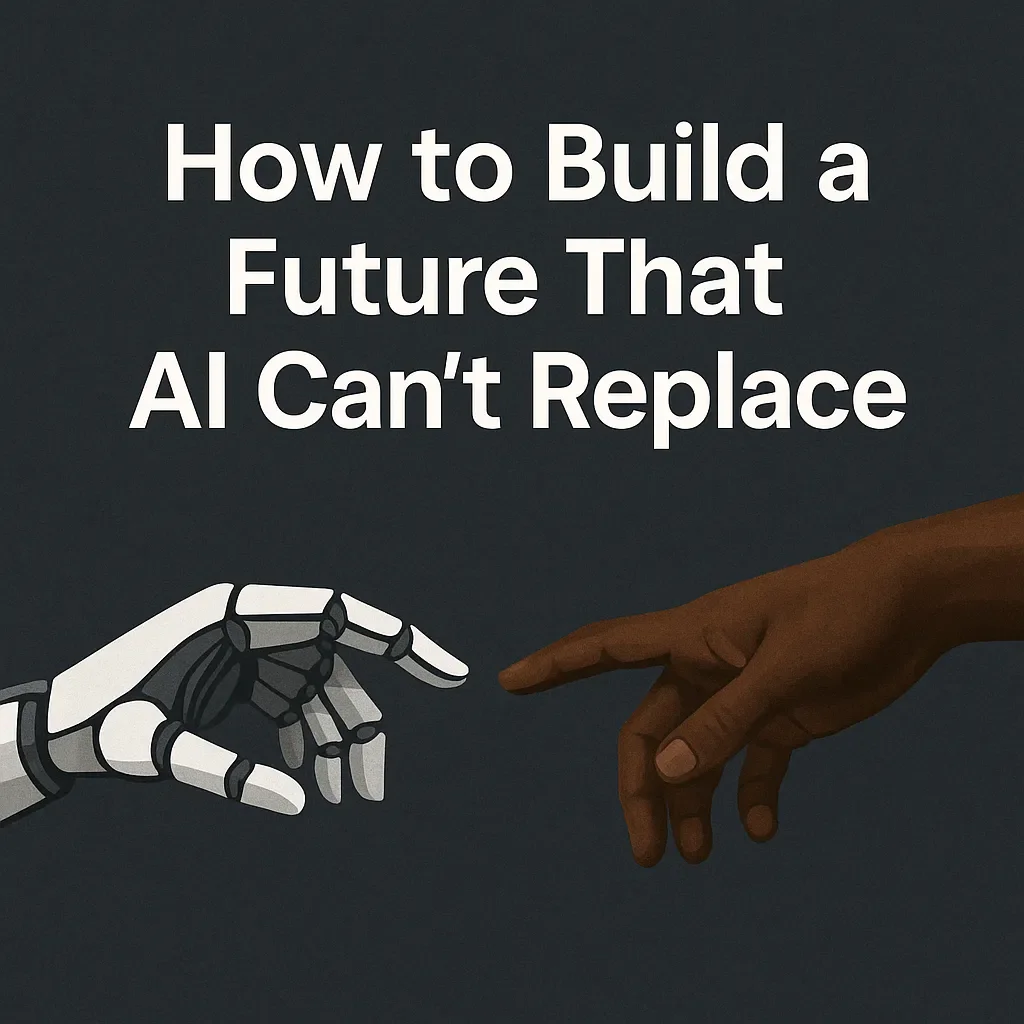
🤖How to Build a Future That AI Can’t Replace
Making smarter career and study choices in the age of AI
Every generation faces a shift in how the world works.
Our grandparents saw globalisation and mass manufacturing.
Our parents lived through the Internet revolution.
Now it’s our turn — the age of AI.
The truth is, the job you’re working toward might not even exist in the future — at least not in the form you’re picturing right now.
To understand what’s happening with AI, it helps to look back at what happened to horses.
In the 19th century, entire industries revolved around horse-drawn transport — blacksmiths, carriage builders, stable hands, and breeders.
Then in 1885, Karl Benz built the first practical automobile, and everything began to change.
By 1908, Henry Ford’s Model T made cars affordable, and within two decades the world transformed.
Stables turned into petrol stations. Horse-related trades vanished.
But while one world ended, another began: mechanics, road builders, car dealerships, insurance, oil refining — all born from the same disruption.
Technology always destroys and creates.
The winners are those who learn how to pivot.
💡 AI is our generation’s automobile moment.
The question isn’t “Will AI take my job?”
It’s “Am I learning how to evolve with it?”
🧠 The AI Reality Check
AI has blurred the lines between what humans and machines can do.
Computers can now assemble data, write essays, analyse markets, and even generate design ideas — often faster (though not always better) than we can.
A recent Financial Times column by Jonathan Guthrie asked:
“In the age of AI, what should your kids study at university?”
It’s a fair question — and one that inspired this newsletter.
AI is reshaping the workplace faster than universities can adapt. From law to finance to design, roles are being redefined.
In the UK, entry-level roles have dropped by almost a third (32%) since the launch of ChatGPT in late 2022, according to research by Adzuna.
Not all of that is directly caused by AI — other factors like rising employer costs, how jobs are designed, and global tensions play a part — but the trend is clear: the world of work is changing fast.
So, if technology can automate so much, what careers are still safe?
And how should we respond — especially those graduating or choosing a degree?
The answer isn’t about finding a single “safe” job.
It’s about developing principles that never go out of date.
💰 The Four Levels of Value
To thrive in the AI age, think less about job titles and more about how you create value.
Myron Golden describes this through the Four Levels of Value — a simple but powerful framework for work, purpose, and progress.
1️⃣ Implementation — Doing the work
You exchange time for money. A cleaner earns less than a plumber because of skill and training, but both rely on time — a limited and valuable resource.
Skilled labour is harder for AI to replace, but time is limited. The next level of value comes from learning to multiply your impact beyond your own hours.
2️⃣ Unification — Managing people and systems
This level is about organisation and management — coordinating teams, processes, and outcomes.
It requires structure, discipline, and operational awareness. You earn more by managing the output of others, not just your own.
3️⃣ Communication — Leadership, persuasion, and influence
This is where true leverage begins. Communicators move people — through storytelling, teaching, vision, and inspiration.
AI can write scripts, but it can’t earn trust or rally people around an idea. Those who lead with authenticity, empathy, and clarity will stand out — and AI will amplify their message.
4️⃣ Creativity — Bringing new ideas into existence
The highest level of value. Creating something new — ideas, products, systems, or art.
Steve Jobs once said, “Creativity is just connecting things.” The people who use AI to create, not compete with it, will win.
Creativity is divine. The very first verse of Genesis says,
“In the beginning God created the heaven and the earth.” (Genesis 1:1)
It’s the first thing we learn about God — that He creates.
Every revolution reorders these levels.
AI won’t eliminate work; it’ll reward higher-level thinking.
🔮 Preparing for What Comes Next
You don’t need to predict the future to prepare for it — you just need to adapt faster than it changes.
The people who will thrive are those who stay curious, who combine ideas across disciplines, and who see AI not as a threat but as a tool.
Because imitation always loses value — but creativity never does.
🌱 Final Thought
No one knows exactly which jobs will exist in 20 years.
But one thing’s certain — change is coming.
The safest strategy isn’t to avoid AI.
It’s to learn how to think, adapt, and create with it — to bring something new and meaningful into the world.
✨ AI doesn’t change these principles; it only amplifies them.