Why exchange rates can boost or wipe out your gains
Imagine investing £10,000 in a global equity ETF.
Over the next year, your investment rises by 10% in US dollars.
You might expect your investment to be worth £11,000.
But what if you checked your account and discovered you’d barely made any money?
Or perhaps you’d made considerably more than 10%?
The difference could be the exchange rate.
When you invest internationally, your returns aren’t determined solely by how well your investments perform. Changes in currency values can also affect what they’re worth in pounds.
Depending on which way currencies move, exchange rates can boost your returns, reduce them or even wipe out your gains.
💷 How Currency Risk Affects Your Returns
Currency risk, also called foreign exchange risk, is the possibility that changes in exchange rates will affect the value of your investments.
Let’s use a simple example.
You invest £10,000 in an overseas investment valued in US dollars when:
£1 = $1.25
Your investment is worth $12,500.
Over the next year, it rises by 10% to $13,750.
But what happens when you convert that money back into pounds?

Illustrative example, excluding fees, taxes and dividends.
The investment rose by 10% in dollars in all three scenarios, yet your return in pounds ranged from 0% to 25%.
When the pound strengthens, each dollar buys fewer pounds, reducing your return in sterling.
When the pound weakens, each dollar buys more pounds, potentially increasing your return.
The investment’s performance and the exchange rate both matter.
🌍 Why Does the US Dollar Matter?
The US dollar is the world’s dominant reserve currency and plays a major role in international trade and financial markets.
Many globally traded commodities, including gold and oil, are priced in dollars. It’s also common for global investment funds to report their performance in USD, even when they invest across several countries.
This means you can invest globally and still regularly encounter the US dollar, regardless of where the underlying investments are based.
And this brings us to ETFs, where things get particularly interesting.
The same ETF can have different currencies associated with it, depending on how it’s structured and traded.
🧩 Three ETF Currencies You Should Understand
Here’s where things can get confusing.
You might buy an ETF in pounds through a UK investment platform and assume you’ve avoided currency risk.
But buying an ETF in pounds doesn’t necessarily mean you’re protected against currency movements.
Let’s use the iShares Core MSCI World UCITS ETF, which tracks an index of large and mid-sized companies across 23 developed markets.
There are three currencies worth understanding.
1. Base Currency
The base currency is the currency a fund uses for its accounting and reporting.
For the iShares Core MSCI World UCITS ETF, that’s USD.
However, the base currency is primarily used for reporting and doesn’t, by itself, determine the currency risk investors face.
2. Trading Currency
The trading currency is the currency you use to buy or sell an ETF on a particular stock exchange.
For example, the same accumulating share class of the iShares Core MSCI World UCITS ETF trades on the London Stock Exchange under two tickers:
SWDA: Traded in GBP.
IWDA: Traded in USD.
You’re buying the same underlying investment, just using different currencies to trade it.
3. Share-Class Currency
The share-class currency is the currency in which a particular class of ETF shares is denominated.
For both SWDA and IWDA, that’s USD, even though SWDA trades in GBP.
However, the fund also offers other share classes, including versions that aim to reduce currency movements against either the pound or the euro.
Here’s how they compare.
📊 Same Fund. Different Currencies and Share Classes.
The underlying fund tracks the MSCI World Index, and its base currency remains USD.
However, the share-class currency, trading currency, income treatment and currency-hedging arrangements can differ.
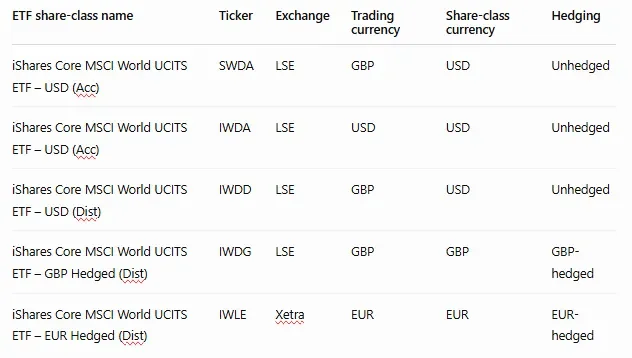
What do these terms mean?
Accumulating (Acc): Dividends are reinvested within the fund rather than paid out to investors.
Distributing (Dist): Dividends are paid out to investors.
Unhedged: Currency movements can affect your investment returns.
GBP-hedged or EUR-hedged: The share class aims to reduce the impact of foreign-currency movements against pounds or euros, respectively.
Here’s the important distinction.
SWDA and IWDA are the same share class, with the same ISIN, but trade in different currencies.
IWDD, IWDG and IWLE are different share classes, with different income or currency-hedging arrangements.
For example, SWDA trades in pounds but remains exposed to foreign-currency movements. IWDG, meanwhile, aims to reduce that exposure against sterling.
Trading currency determines how you buy an ETF. Currency hedging helps manage its exchange-rate risk.
💸 Don’t Forget FX Fees
Currency movements aren’t the only thing to consider.
Your investment platform may also charge you to exchange currencies.
For example, if you invest £5,000 and your platform charges a 0.75% foreign-exchange conversion fee, that’s £37.50 in fees.
You could also face another conversion fee when selling.
This is where trading currency matters.
If your account holds GBP, buying SWDA in GBP may avoid a separate currency-conversion fee, whereas buying IWDA in USD could trigger one.
The same principle applies to investors holding euros who purchase ETFs traded in another currency.
Before investing, check the currency held in your account, the ETF’s trading currency and your platform’s FX charges.
Avoiding an FX fee doesn’t mean you’re avoiding currency risk.
🛡️ Should You Consider Currency Hedging?
If you want to reduce the impact of exchange-rate movements, one option is a currency-hedged ETF.
For example, the iShares Core MSCI World UCITS ETF offers:
IWDG: A GBP-hedged share class.
IWLE: A EUR-hedged share class.
These aim to reduce the impact of foreign-currency movements against pounds and euros, respectively.
Remember our earlier example where a 10% investment gain disappeared because the pound strengthened?
Currency hedging aims to reduce that effect.
But hedging works both ways. If the pound weakens, an unhedged investment may benefit, while a hedged investment generally gives up much of that additional gain.
Hedging also involves costs and trade-offs. ETFs typically use financial contracts to manage currency exposure. Transaction costs and differences in interest rates between currencies can affect returns, sometimes positively and sometimes negatively.
Hedging can reduce currency risk, but it doesn’t eliminate it. Nor is it automatically the better option.
⏳ What If You’re Investing for the Long Term?
If you’re investing in global equities for the next 20 or 30 years, do you really need to hedge your currency exposure?
Not necessarily.
Over time, the performance of the companies you own can become a major driver of your returns. Currency movements still matter, but some investors prefer to accept those fluctuations rather than incur the costs of hedging.
Currency risk doesn’t disappear over time. The question is whether reducing it makes sense for your investment goals.
🔍 Three Things to Check Before Investing
1. Understand your currency exposure. Look at the currencies of the underlying investments and whether the ETF is hedged.
2. Check for FX fees. If your platform needs to convert money to buy or sell an ETF, find out what it charges.
3. Consider your investment horizon. Are you investing for decades, or will you need the money in pounds relatively soon? This can influence whether hedging makes sense.
💭 The Bottom Line
Exchange rates can boost or reduce your investment returns, even when the underlying investments perform well.
For long-term investors, currency risk isn’t necessarily something to eliminate, but it’s important to understand.