Understanding concentration risk in your investment portfolio
When you start investing, one of the first things you’ll probably hear about is diversification.
Or, in much simpler terms “Don’t put all your eggs in one basket.”
And today, putting that idea into practice has arguably never been easier.
With a single fund or ETF, you can invest in hundreds or even thousands of companies across different sectors and countries.
Maybe you own an S&P 500 ETF. Perhaps you also have a global equity fund. Your workplace pension is invested somewhere in the background.
You might even own a few individual shares in companies you know and use, such as Apple, Nvidia or Amazon.
That sounds diversified.
But underneath these different investments, you could be owning many of the same companies again and again.
And some have become so large that they represent a significant part of the world’s biggest stock-market indices.
Which brings us to the Magnificent Seven.
🌟 Who Are the Magnificent Seven?
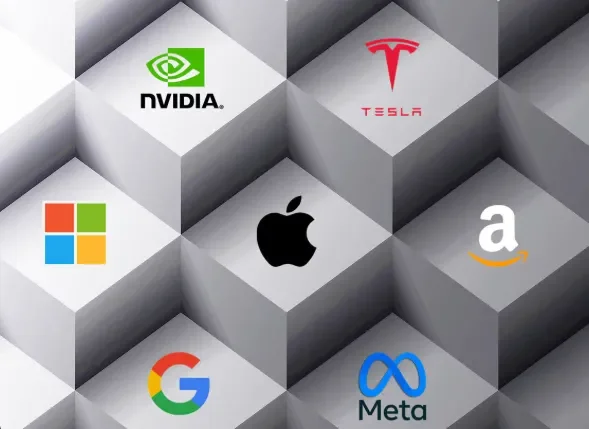
The Magnificent Seven is the nickname given to seven giant US companies:
Apple
Microsoft
Alphabet
Amazon
Nvidia
Meta
Tesla
The term was popularised in 2023 by Bank of America strategist Michael Hartnett, borrowing the name from the film The Magnificent Seven.
They had become some of the largest and best-performing companies in the world, with an outsized influence on the US stock market.
And importantly, they’ve created enormous wealth for investors.
So this isn’t an argument that the Magnificent Seven are bad investments.
The risk isn’t owning them. It’s owning more of them than you realise.
And that brings us to concentration risk.
🥚 What Is Concentration Risk?
Concentration risk is simply the risk of having too much of your portfolio dependent on a relatively small number of investments.
That can happen across companies, sectors, countries or asset classes.
For example, imagine £7,000 of your £10,000 portfolio is invested in one company.
If it performs well, great. But if it struggles, 70% of your portfolio is exposed to that one company.
But concentration isn’t always that obvious.
📈 How 500 Stocks Can Still Be Concentrated
The S&P 500 gives you exposure to 500 leading US companies, but your money isn’t necessarily divided equally between them.
A standard S&P 500 tracker is market-cap weighted, meaning companies receive a larger share of the index based on their market value.
Think of it like a pie. There may be 500 companies, but the biggest companies get much bigger slices.
As of 30 September 2026, Nvidia alone represented 8.4% of the S&P 500, while the 10 largest holdings represented 39.1%.
Those top 10 included all seven Magnificent Seven companies, alongside Broadcom and Micron. Alphabet appears twice because both its Class A and Class C shares are included.
The Magnificent Seven alone represented around 34% of the index in late September.
So if you invested £10,000 in a standard S&P 500 tracker, roughly:
£840 would be exposed to Nvidia alone.
£3,400 would be exposed to the Magnificent Seven.
£3,910 would be exposed to the 10 largest holdings.
That’s nearly £4 of every £10 concentrated in just 10 holdings, despite investing across 500 companies.
🌍 Now Let’s Go Global
Maybe you decide you want more diversification, so you invest in the MSCI World.
That gives you exposure to more than 1,200 companies across 23 developed markets.
But MSCI World is also market-cap weighted.
As of 30 September 2026, the Magnificent Seven represented approximately:
Nvidia: 5.81%
Apple: 5.41%
Microsoft: 4.00%
Alphabet: 3.99%
Amazon: 2.67%
Meta: 1.76%
Tesla: 1.12%
Together, that’s around 24.8% of MSCI World.
So if you invested £10,000, roughly £2,480 would be exposed to just seven companies, despite owning more than 1,200.
And the concentration isn’t just in individual companies.
The USA also accounts for around 72% of MSCI World, meaning a large part of your investment is still tied to one country.
That doesn’t mean MSCI World isn’t diversified. It simply means that investing globally doesn’t necessarily mean your money is evenly spread around the world.
🔁 Different Fund. Same Companies.
Now imagine you own an S&P 500 ETF, an MSCI World ETF and a workplace pension invested in global equities.
You might think you’re spreading your money across three different investments.
But look at what those funds actually own, and you’ll often find the same seven companies:
Nvidia. Apple. Microsoft. Alphabet. Amazon. Meta. Tesla.
Again that’s because many popular indices are market-cap weighted, and these companies are among the largest in the world.
So while you’re investing through different funds, you may be buying the same companies multiple times.
More funds don’t necessarily mean more diversification. Sometimes they just mean more overlap.
And if you then buy shares in Apple, Amazon or Nvidia directly, you’re increasing your exposure to companies you may already own through your funds and pension.
There’s nothing wrong with that if it’s intentional.
The important thing is knowing how much you already own before adding more.
🧩 Concentration Isn’t Just About Companies
You can also become concentrated in particular sectors.
The Global Industry Classification Standard (GICS) groups companies into 11:
Information Technology
Financials
Health Care
Consumer Discretionary
Communication Services
Industrials
Consumer Staples
Energy
Utilities
Real Estate
Materials
Interestingly, the Magnificent Seven aren’t all classified as technology companies.
Nvidia, Apple and Microsoft are Information Technology. Alphabet and Meta are Communication Services. Amazon and Tesla are Consumer Discretionary.
But the wider S&P 500 is still heavily exposed to technology. As of 30 September 2026, Information Technology represented around 38% of the index.
So don’t only ask how many companies you own.
Ask which sectors are actually driving your portfolio.
🪙 What About Asset Classes?
Concentration isn’t limited to companies, sectors or countries. You can also have too much of your portfolio invested in one asset class.
For example, some younger investors first entered investing through Bitcoin or other digital assets. Owning several cryptocurrencies might feel diversified, but if they make up most of your portfolio, you’re still heavily dependent on the performance of digital assets.
The same applies if virtually everything you own is invested in shares.
Different asset classes, including equities, bonds, commodities and digital assets, can behave differently as markets and the economy change.
Diversifying across asset classes can help reduce your reliance on any one type of investment.
🛠️ So What Can You Do?
You don’t necessarily need more investments. You need to understand what you already own and where your portfolio might be concentrated.
1. Look Under the Bonnet 🔍
Don’t just look at the name of your ETF or fund.
Check its top 10 holdings, sector breakdown and country exposure. Most fund providers publish this information in their factsheets.
And don’t forget your pension. It forms part of your overall investment portfolio too.
2. Check for Overlap 🔁
Before buying another ETF, ask:
“Am I diversifying, or just buying more of what I already own?”
An S&P 500 ETF and an MSCI World ETF, for example, may have different names but share many of the same largest companies.
More ETFs don’t necessarily mean more diversification.
3. Explore Different Weighting Strategies ⚖️
Not every index gives the biggest companies the biggest weights.
An equal-weight S&P 500 strategy allocates roughly 0.2% to each constituent at rebalancing, reducing the dominance of companies like Nvidia and Apple.
This introduces different risks, including greater exposure to smaller S&P 500 companies, but it demonstrates that how an index is weighted matters.
4. Look Beyond Your Biggest Exposures 🌍
If your portfolio is heavily concentrated in US equities, you could explore indices such as MSCI World ex USA, which covers developed markets outside the USA.
You could also explore European equities, emerging markets or smaller companies.
And depending on your goals, other asset classes, such as bonds, may have a role alongside equities.
The aim isn’t to own everything. It’s to add exposure that serves a different purpose.
5. Review Your Entire Portfolio in One Place 📱
Professional investors use portfolio analytics tools to understand their exposure across companies, sectors, countries and asset classes.
You can do something similar.
Platforms such as Sharesight and Parqet can help you consolidate investments and analyse your holdings, although the depth of ETF analysis and available integrations varies.
Rather than reviewing your ISA, pension and trading accounts separately, try to understand what you own across all of them.
The goal is simple: know where your money is invested and which risks you’re taking.
🍱 The “Free Lunch” of Investing
There’s a famous idea associated with Nobel Prize-winning economist Harry Markowitz that diversification is the closest thing investing has to a “free lunch.”
By spreading your investments, you can reduce your reliance on any one company, sector or country.
That doesn’t mean concentration is always bad. You might deliberately choose to invest more heavily in an area you believe in.
The important thing is understanding where your money is concentrated and making that choice intentionally.
Because ultimately, diversification isn’t about owning everything. It’s about not having too much riding on one thing.